What Size Space Heater Do I Need?
One rule, one table and three adjustments. Five minutes here saves buying the wrong heater twice.
The short answer
RapidHeat from $59
Free USA shipping · 30-day return window · Published store policies
Step 1: measure the room
Multiply length by width in feet. A 10 by 12 foot bedroom is 120 square feet. That number is all the base calculation needs.
Step 2: apply 10 watts per square foot
120 square feet × 10 = 1,200 watts. This assumes a reasonably insulated room with an 8 foot ceiling in a moderate climate. It is the standard industry starting point used by most heater manufacturers and covered in general terms by the Department of Energy's guidance on small space heaters.
| Room | Square feet | Watts needed | Units |
|---|---|---|---|
| Closet office / bathroom (5x10) | 50 | ~500 W | 1 |
| Small office / nursery (8x10) | 80 | ~800 W | 1 |
| Standard bedroom (10x12) | 120 | ~1,200 W | 1 |
| Large bedroom (12x14) | 168 | ~1,680 W | 1–2 |
| Home office (12x15) | 180 | ~1,800 W | 2 |
| Small living room (14x16) | 224 | ~2,240 W | 2 |
| Living room (15x20) | 300 | ~3,000 W | 2 |
| Large den / bonus room (18x24) | 432 | ~4,320 W | 3, zone heating |
| Open plan (20x30) | 600 | ~6,000 W | 3+, zone heating |
Step 3: the adjustments that actually change the number
- Insulation. Poorly insulated or older construction: add 25%. Newly built and well sealed: subtract 10%.
- Ceiling height. A 10 foot ceiling is 25% more air volume than an 8 foot one. Scale accordingly; vaulted ceilings need a larger adjustment still.
- Windows and exposure. Large single-pane windows, a north-facing wall or a room over an unheated garage all add load. Add 10 to 20%.
- Climate zone. In colder US regions, add 15 to 25% on top of the base figure even in a well-insulated home, since outdoor temperature differential drives more heat loss.
Key takeaway
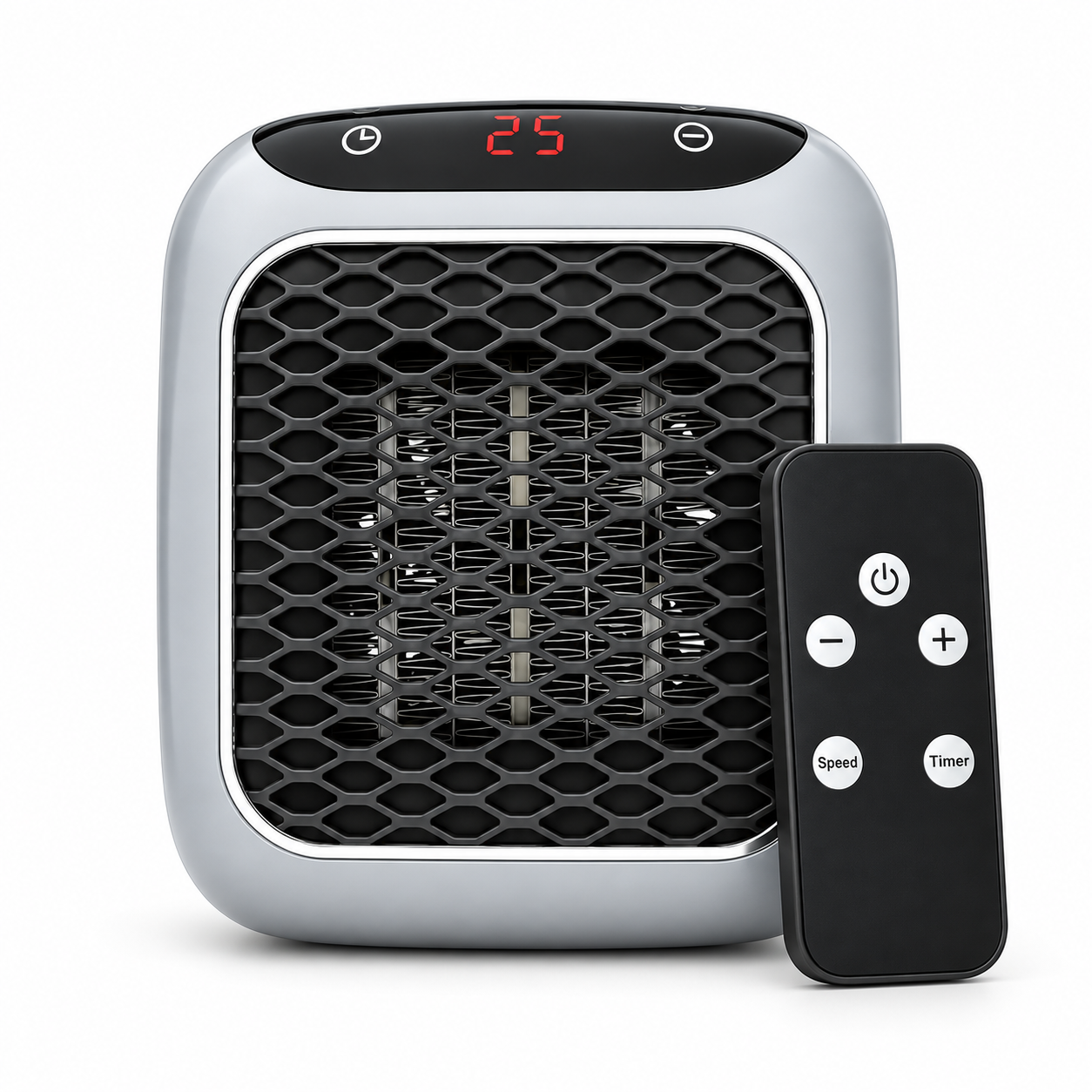
Recommended in this guide
The compact heater this guide keeps coming back to
RapidHeat is a portable ceramic fan heater for personal and supplemental room heating. Room results depend on insulation, drafts, ceiling height and starting temperature; it is not a whole-home heating replacement.
- Ceramic fan heating
- Remote control included
- Programmable timer
Worked example 1: a well-insulated 12x14 bedroom
168 square feet × 10 W = 1,680 W baseline. The room is newly built with good windows, so subtract 10%: about 1,512 W. A single 1,500 watt ceramic heater is the right call here — see the full bedroom heater guide.
Worked example 2: an older, drafty 180 sq ft home office
180 square feet × 10 W = 1,800 W baseline. The room is in an older house with a single large window and a 9 foot ceiling, so add 25% for insulation and 10% for the window and ceiling: roughly 2,500 W total. That is above what one plug-in heater should carry, so the practical answer is two 1,200-1,500 watt units on separate circuits rather than one heater run continuously at its maximum. See heating a cold, drafty room.
How many heaters for multiple rooms
Heaters are built to warm one enclosed room, not to push heat through doorways and hallways into adjoining spaces. If you regularly use two or three rooms — a bedroom, an office and a living area — plan for one correctly sized unit per room rather than a single heater carried from room to room, or one large heater expected to cover an open layout. This is exactly why the two and three-unit bundles exist.
The plug-in ceiling
A standard US wall outlet on a 15 amp circuit supports roughly 1,800 watts, and heaters are built to stay safely below that at around 1,500. If your calculation comes out above 1,500 watts, the answer is two units on separate circuits rather than one enormous heater. See heating a large room.
Why oversizing backfires
A heater much larger than the room blasts to temperature, shuts off, cools, and blasts again. You get hot-cold swings, more fan noise and a less comfortable room than a correctly sized unit ticking along on a thermostat. Comfort comes from steady output, not peak output.
What to look for, and what to avoid when sizing
| Look for | Avoid |
|---|---|
| A stated coverage area in square feet from the manufacturer | Vague "heats any room" claims with no size guidance |
| Sizing based on your actual room, not the biggest number available | Buying the highest-wattage unit "to be safe" |
| Two correctly sized units for two rooms in regular use | One oversized heater carried between rooms all winter |
| A thermostat that holds a set temperature once sized correctly | Relying on manually switching a heater on and off all day |
Where RapidHeat fits
RapidHeat is intended for personal or supplemental room heating. Match any heater to the room using its documented wattage plus ceiling height, insulation, windows and drafts. Multi-unit bundles are intended for separate occupied rooms, not as a substitute for correctly sized primary heating. See bundle pricing.
Common questions
How many watts per square foot does a space heater need?
About 10 watts per square foot for a reasonably insulated room with standard 8 foot ceilings. Increase it for poor insulation, high ceilings, large windows or a very cold climate.
What size heater do I need for a 12x12 room?
A 12 by 12 foot room is 144 square feet, so around 1,440 watts. A compact 1,500 watt heater is the right fit.
Is a bigger heater always better?
No. An oversized heater cycles on and off harder, feels drafty and is louder. A correctly sized unit with a good thermostat holds a steadier, more comfortable temperature.
Do I need a different heater for a cold climate zone?
Yes, as a rule of thumb. In colder US climate zones, add 15 to 25% to the base wattage figure to account for greater heat loss through walls and windows, even in an otherwise well-insulated home.
How many heaters do I need for a whole floor or multiple rooms?
One per occupied room is the general rule, since heaters are built to warm a single enclosed space rather than push heat through doorways and hallways. Two rooms in regular use usually calls for a two-pack rather than one oversized heater moved back and forth.
Does ceiling height really change the wattage I need?
Yes. Wattage guidelines assume an 8 foot ceiling. A 10 foot ceiling has 25% more air volume to heat, and vaulted or open-to-above ceilings can add considerably more, so scale your wattage estimate up accordingly.
Why buy direct from RapidHeat US
- Official US store — the same team that handles warranty claims
- Free shipping to eligible US delivery addresses
- 30-day return window and a 12-month limited warranty
- US-based email and phone support, not a marketplace reseller
Sources & how we got these numbers
- Department of Energy — Small Space Heaters — Basis for the general watts-per-square-foot sizing guidance used above.
- U.S. Energy Information Administration — Electric Power Monthly — Source for average US residential electricity rates used in cost estimates.
- National Fire Protection Association — Home Heating Safety — Safe placement guidance relevant to multi-unit setups.
Costs are illustrative and calculated at the US average residential electricity rate. Your own rate, room and usage will change the result. See our editorial standards.
Keep reading
Ready to warm the room you're actually in?
Bundles start at $59 with free eligible US shipping and a 30-day return window.
See bundles & order