RapidHeat vs Traditional Heaters
A fair side-by-side look at how a compact ceramic heater stacks up against central heating, oil-filled radiators, baseboard heat and standard fan heaters.
The short answer
RapidHeat from $59
Free USA shipping · 30-day return window · Published store policies
| Feature | RapidHeat | Central heating | Oil-filled radiator | Baseboard heat | Basic fan heater |
|---|---|---|---|---|---|
| Time to feel warm | Directed fan-assisted warmth | 15–40 minutes | 15–30 minutes | 20–40 minutes | 1–3 minutes |
| What it heats | Personal or supplemental room heat | Every room in the house | One room | One fixed room | One room |
| Noise | Fan sound; no verified dB figure published | Silent to moderate | Silent | Silent | Often loud |
| Portability | Carry it in one hand | Fixed | Heavy, wheeled | Fixed, hard-wired | Portable |
| Controls | Remote, timer, thermostat | Thermostat / schedule | Dial, sometimes timer | Wall thermostat | Usually a dial |
| Footprint | Palm-sized | Ductwork/furnace, out of sight | Floor-standing, bulky | Wall-length unit | Small, compact |
| Best used for | The room you're in, right now | Whole-home baseline warmth | Long steady background heat | Permanent single-room heat | Quick blasts of heat |
Central heating
Central heating is the right tool for keeping a whole house above a safe baseline temperature. It is the wrong tool for one person who wants to be warm in one room for three hours, because it heats every room whether anyone is in it or not. That mismatch is the whole reason supplemental heaters exist — see space heater vs central heating for the full breakdown of when each makes sense.
Worked example: one occupied room vs whole-house heat
Say you're the only one home and awake in a 150 sq ft home office for 4 hours on a cold evening. Running a 1,500W RapidHeat for that period costs about 1.5 kW × 4 hours × $0.17/kWh = $1.02, illustrative at the US average residential rate. Running a central furnace to keep an entire 1,800 sq ft house at the same comfort level for those same 4 hours will typically cost several times that, because it's conditioning rooms nobody is using. The math flips once more than two or three rooms need to be warm at once — that's when central heating becomes the more efficient choice again.
Recommended in this guide
The compact heater this guide keeps coming back to
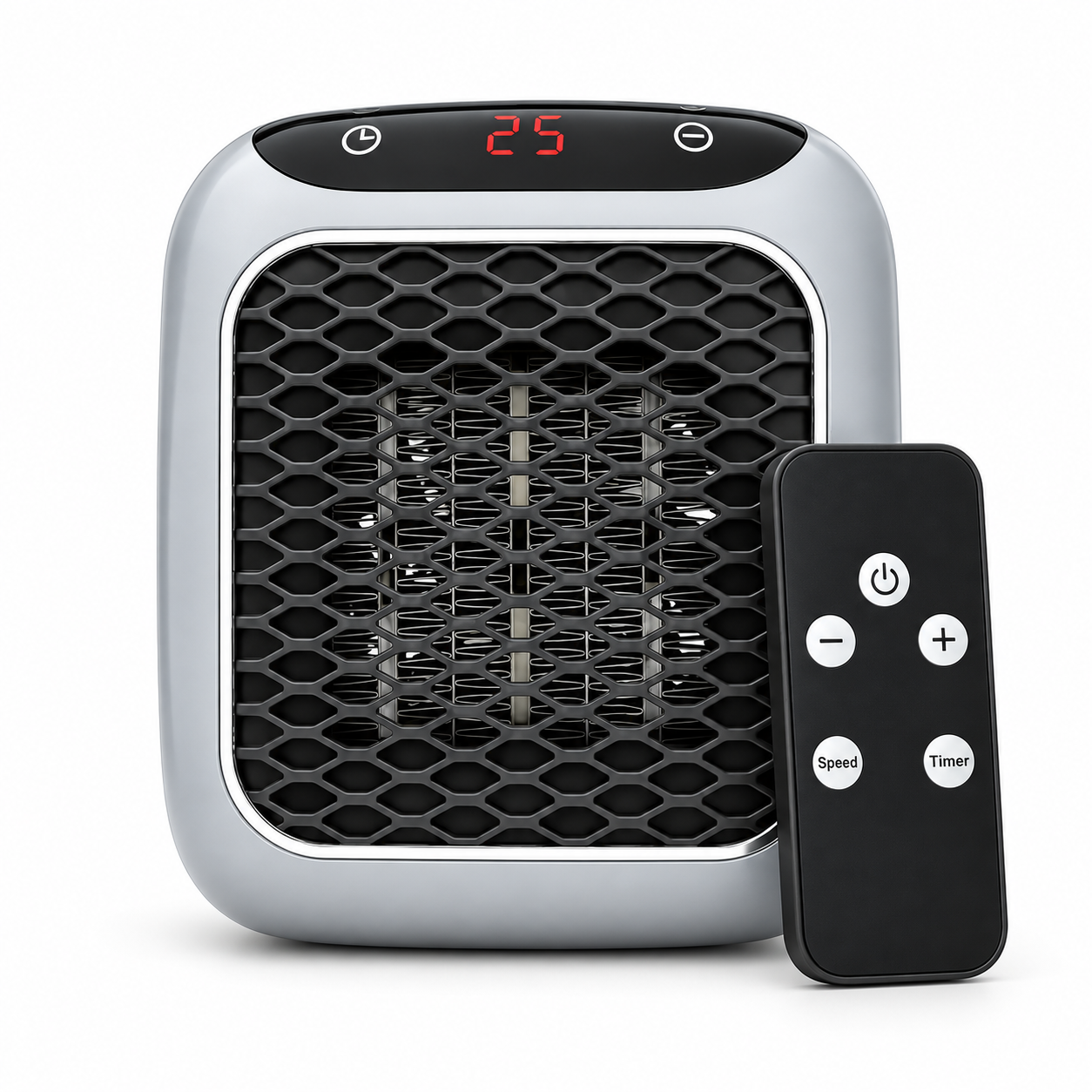
RapidHeat is a portable ceramic fan heater for personal and supplemental room heating. Room results depend on insulation, drafts, ceiling height and starting temperature; it is not a whole-home heating replacement.
- Ceramic fan heating
- Remote control included
- Programmable timer
Oil-filled radiators
Oil radiators give steady background heat and are silent, which makes them appealing for bedrooms. The trade-off is weight and lag: they are awkward to move and take fifteen minutes or more before you feel anything, and most lack a remote or fast digital control.
Baseboard heaters
Hard-wired electric baseboard heat is common in older homes and apartments without ducted heating. It's reliable and silent, but it's fixed in place, slow to respond, and usually controlled by a basic wall thermostat with no timer or remote. It suits a room that needs to be permanently warm rather than one you want to heat on demand.
Basic fan heaters
A cheap fan heater is fast, but it is usually loud, has no thermostat, offers no timer and typically lacks the safety cut-offs of a modern ceramic unit. You feel the heat in front of it and very little elsewhere in the room.
What to look for, and what to avoid when comparing
- Look for: published wattage, a thermostat, and safety cut-offs on any plug-in unit you're comparing against RapidHeat
- Look for: whether the alternative can be moved room to room, if that's what you actually need
- Avoid: assuming a bulkier or heavier heater is automatically more powerful — wattage, not size, determines heat output
- Avoid: replacing whole-house central heating entirely with space heaters; it typically costs more once several rooms need warmth at once
RapidHeat is not trying to replace your furnace. It's trying to make the room you're actually sitting in warm without heating five empty ones at the same time.
Key takeaway
Where RapidHeat lands
RapidHeat is aimed squarely at the gap: near-instant warmth like a fan heater, quiet enough to sleep beside like an oil radiator, with a thermostat, timer, remote and safety cut-offs — in something you can carry in one hand. It is a supplement to your heating, not a replacement for it.
Curious what it would cost you to run? Try the running cost calculator or see bundle pricing.
Common questions
Is RapidHeat better than central heating?
Not for whole-house warmth — central heating is the right tool for that. RapidHeat is better for warming the one room you're in right now without running the furnace for the whole house.
Is RapidHeat quieter than a fan heater?
RapidHeat uses a fan, so some operating sound is expected. We do not publish a verified decibel measurement; compare independently measured results if noise is a deciding factor.
Does RapidHeat cost more to run than an oil-filled radiator?
At the same wattage, running cost is identical — both are resistance heaters that convert electricity to heat at essentially the same efficiency. The difference is in usage pattern: RapidHeat's fast warm-up and thermostat often mean fewer total running hours to reach comfort.
Can RapidHeat replace a baseboard heater?
For a single room, often yes, with the advantage of portability and a timer/remote. A hard-wired baseboard system is better suited to permanently and continuously heating a fixed room as part of a whole-house plan.
Why is central heating slower to feel warm than a plug-in heater?
Central systems have to warm ductwork or radiators and push air or water through the whole house before it reaches your room, which typically takes 15 to 40 minutes. A heater sitting a few feet away skips that entirely.
Which is the cheapest option overall?
It depends on how much of the house you actually need warm. Heating one occupied room with a plug-in heater is usually cheaper than running central heating for an empty house; heating the whole house is cheaper with central heating than running several space heaters at once.
Why buy direct from RapidHeat US
- Official US store — the same team that handles warranty claims
- Free shipping to eligible US delivery addresses
- 30-day return window and a 12-month limited warranty
- US-based email and phone support, not a marketplace reseller
Sources & how we got these numbers
- Energy.gov — Small Space Heaters — How supplemental heating compares with central systems.
- EIA — Electric Power Monthly — US average residential electricity rate used in cost examples.
- NFPA — Home Heating Safety — Safe use guidance across heater types.
Costs are illustrative and calculated at the US average residential electricity rate. Your own rate, room and usage will change the result. See our editorial standards.
Keep reading
Ready to warm the room you're actually in?
Bundles start at $59 with free eligible US shipping and a 30-day return window.
See bundles & order