Best Space Heater for an Apartment
Renters have a specific set of problems no homeowner heating guide addresses: no installation, shared circuits, thin walls, and heat you don't control.
The short answer
RapidHeat from $59
Free USA shipping · 30-day money-back guarantee · Ships within 24 hours
Why apartments need a different answer
Most heater buying guides assume you own the place and can install whatever you like. In a rental, several constraints show up that homeowners rarely think about: you cannot bolt anything to a wall or modify wiring without permission, you may be on an older shared electrical panel with less headroom than a newer home, a noisy heater is a neighbor problem rather than just your own, and landlord-provided heat is frequently set lower than residents would like, especially in older buildings with a single building-wide thermostat.
Ranking heater types for apartment use
| Type | Installation | Noise | Best for renters? |
|---|---|---|---|
| Compact ceramic (PTC) plug-in | None — plug into any outlet | Low, often under 30 dB | Best overall fit |
| Oil-filled radiator | None, but heavy and slow to move | Silent | Good if you pre-heat before evening |
| Infrared panel heater | None, but bulkier footprint | Silent | Fine for one fixed spot, weak for a whole room |
| Basic fan heater | None | Often loud | Cheapest but least neighbor-friendly |
| Wall-mounted or hardwired heater | Requires electrical work | Varies | Usually against lease terms — avoid |
Sizing a heater to your apartment room
The rule of thumb is about 10 watts per square foot of reasonably insulated space. Most apartment bedrooms and living rooms fall comfortably within what one compact unit can cover; only large open-plan living rooms typically need a second heater.
| Room size | Approx. wattage needed | RapidHeat units recommended |
|---|---|---|
| Studio corner / small bedroom (up to 100 sq ft) | ~1,000 W | 1 unit |
| Standard bedroom or home office (100-130 sq ft) | ~1,000-1,300 W | 1 unit |
| Larger living room (130-250 sq ft) | ~1,300-2,500 W | 2 units in different parts of the room |
| Whole small studio apartment (open plan) | ~2,500-3,000 W | 2-3 units, one per occupied zone |
For a more precise estimate based on ceiling height and insulation, see what size space heater do I need. This is also why the two-pack is the most common choice among apartment customers — one unit for the bedroom and one for the living room, run separately rather than at the same time to keep the load light.
Recommended in this guide
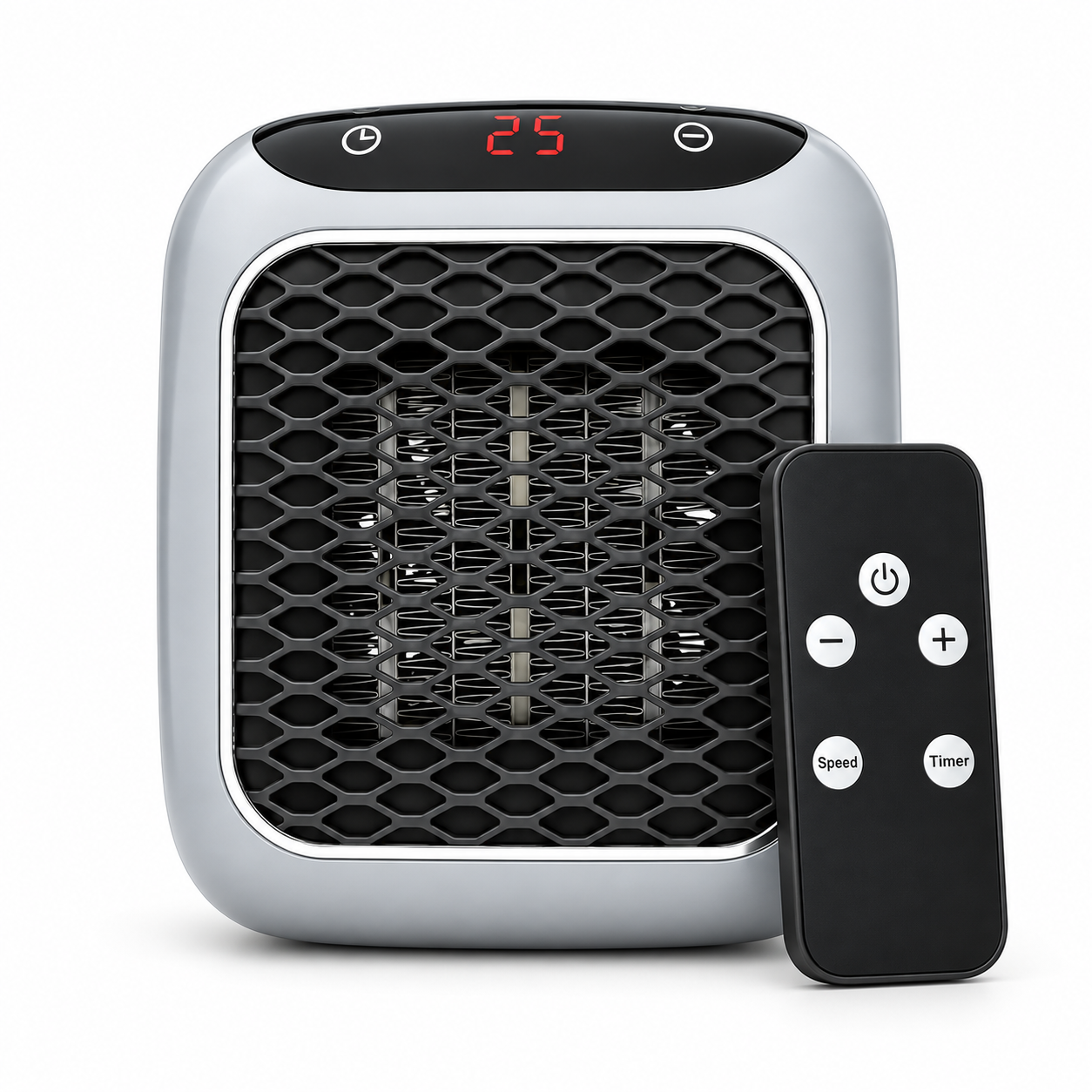
The compact heater this guide keeps coming back to
RapidHeat is a hand-sized ceramic heater that plugs straight into a wall outlet, pushes out warm air in about a minute and switches itself off on a timer. It is built for warming one room properly, not a whole house.
- Warm in ~60 seconds
- Under 30 dB
- Auto shut-off & timer
Circuit limits in older buildings
A 1,500-watt heater draws about 12.5 amps, which is a meaningful chunk of a standard 15-amp household circuit. In an older apartment building, that circuit may already be shared with a lamp, a TV, or a kitchen outlet a few feet away. Plug the heater directly into a wall outlet, avoid running it on the same circuit as another high-draw appliance like a microwave or space heater in an adjoining room, and if a breaker trips repeatedly, that is a sign to use a different outlet rather than push through it. This is standard practice with any electric heater, not specific to any one brand.
“My apartment's baseboard heat barely reaches the bedroom. I plug this in for an hour before bed and it makes the room usable without touching the thermostat for the whole unit.”
Noise and neighbors
In a building with shared walls, a heater's fan noise matters more than it would in a detached house. Look for a stated decibel figure rather than marketing language like "quiet." RapidHeat runs under 30 dB, which is below the level of normal conversation, so it should not be audible through a wall or bother anyone in the next room. Our quiet space heater guide explains what decibel numbers actually mean in practice.
Heating one room instead of the whole apartment
If the living room is where you spend the evening, heating just that room with a compact unit is generally far cheaper than raising the thermostat for the entire apartment, particularly in an older building with poor insulation between units. A 1,500-watt heater run for 4 hours costs about $1.02 at the US average residential rate of $0.17 per kWh (1.5 kW x 4 hours x $0.17), which is often less than the incremental cost of raising a whole-apartment thermostat by a few degrees for the same evening. See what a space heater costs to run for the full breakdown, or estimate your own numbers.
What to look for before you buy
- No installation required — purely plug-in.
- A stated noise level under 30 dB if you share walls.
- A thermostat and timer so it is not running at full output unattended.
- Overheat protection and tip-over shut-off, especially in a smaller apartment room.
- Compact size that is easy to move between rooms, or take with you when you move out.
Common questions
What is the best type of heater for an apartment?
A compact plug-in ceramic (PTC) heater is generally the best fit for apartments: no installation, warms up fast, includes a thermostat and timer, and draws modest power that works on a standard outlet without tripping shared circuits.
Can I use a space heater in an apartment with older wiring?
Usually yes, as long as it is plugged directly into a wall outlet rather than an extension cord, and you avoid running other high-draw appliances on the same circuit at the same time. A 1,500-watt heater is close to the limit of a standard 15-amp circuit, so check what else is on that circuit.
Will a space heater bother my neighbors?
A quality ceramic heater running under 30 dB is quieter than normal conversation and should not be audible through a shared wall. Cheap fan heaters can be noticeably louder, so noise level is worth checking before you buy in an apartment.
Is it cheaper to heat one room or the whole apartment?
Heating just the room you are in almost always costs less than running central heat for a whole apartment, especially if you spend most evenings in one living room or bedroom. The savings come from heating less space, not from the heater itself being unusually efficient.
Can I install a wall heater in a rented apartment?
Generally no, without landlord permission — most leases prohibit modifications to electrical or wall fixtures. A plug-in portable heater avoids that issue entirely since it requires no installation and moves with you when you leave.
What if my landlord keeps the heat too low?
Many renters supplement inadequate landlord-provided heat with a portable heater in the room they use most. Check your lease and local tenant heating regulations, but a plug-in heater used safely is rarely an issue since it requires no changes to the unit.
Why buy direct from RapidHeat US
- Official US store — the same team that handles warranty claims
- Free shipping from a US warehouse, dispatched within 24 hours
- 30-day money-back guarantee and a 12-month warranty
- US-based email and phone support, not a marketplace reseller
Sources & how we got these numbers
- US Energy Information Administration — Electricity Monthly — average US residential electricity price used for cost estimates
- Department of Energy — Small Space Heaters — background on wattage and efficient portable heater use
- NFPA — Home Heating Safety — general safety guidance for portable heating equipment
Costs are illustrative and calculated at the US average residential electricity rate. Your own rate, room and usage will change the result. See our editorial standards.
Keep reading
Ready to warm the room you're actually in?
Bundles start at $59 with free USA shipping and a 30-day money-back guarantee.
See bundles & order