Space Heater Safety in a Baby's Room
A nursery deserves the most careful thinking of any room in the house. Here is how to approach a plug-in heater sensibly, and where we think you should simply not use one unattended.
The short answer
Start with your pediatrician, not a product page
Nothing on this page is medical advice, and we are not going to pretend otherwise. Every baby, home and situation is different, and your pediatrician is the right source for guidance on your baby's sleep environment, clothing and bedding. What we can speak to is how a plug-in space heater works, what it can and cannot safely do in a room with an infant, and the general safety habits that apply to any heater near any sleeping child.
Key takeaway
General guidance on nursery temperature
Sleep-safety resources commonly describe a comfortably cool room, often in the range of 68 to 72°F, as more appropriate for infant sleep than an overheated one, since overheating has been raised as a factor to avoid in infant sleep-safety guidance generally. That said, this is general public information and not a substitute for advice from your own pediatrician, who can account for your baby's health, age, and home. Use a simple room thermometer rather than judging the temperature by hand, since a room can feel cooler or warmer to an adult than it actually is.
| What to check | General guidance | Why it matters |
|---|---|---|
| Room temperature | Often cited around 68-72°F as a comfortably cool range | Overheating is a factor sleep-safety guidance advises against |
| Distance from crib to any heater | At least 3 feet, ideally heater across the room | Reduces fire risk and prevents direct heat on the baby |
| Cord placement | Fully out of reach, not under rugs or walkways | Prevents pulling, tripping, and cord damage |
| Heater operation | Attended only; off before leaving the baby unattended | No heater should be relied on unattended near an infant overnight |
| Bedding and clothing | Follow pediatrician guidance rather than adding a heater to compensate | Appropriate sleepwear addresses cold better than extra heat sources |
If you use a heater to warm a nursery before bedtime
- Run it earlier in the evening, before the baby is put down, with the door open so the whole room warms evenly.
- Turn it off, or let a timer switch it off, well before the baby is left alone in the room.
- Keep it at least three feet from the crib, curtains, bedding and anything a curious older sibling could touch.
- Place it on a stable, flat surface where it cannot be pulled or knocked over.
- Route the cord along a wall, out of reach of the crib and away from any area a baby could later crawl to.
- Use a unit with genuine overheat protection and tip-over shut-off as a baseline safety feature, never a bare fan heater without safety cut-offs.
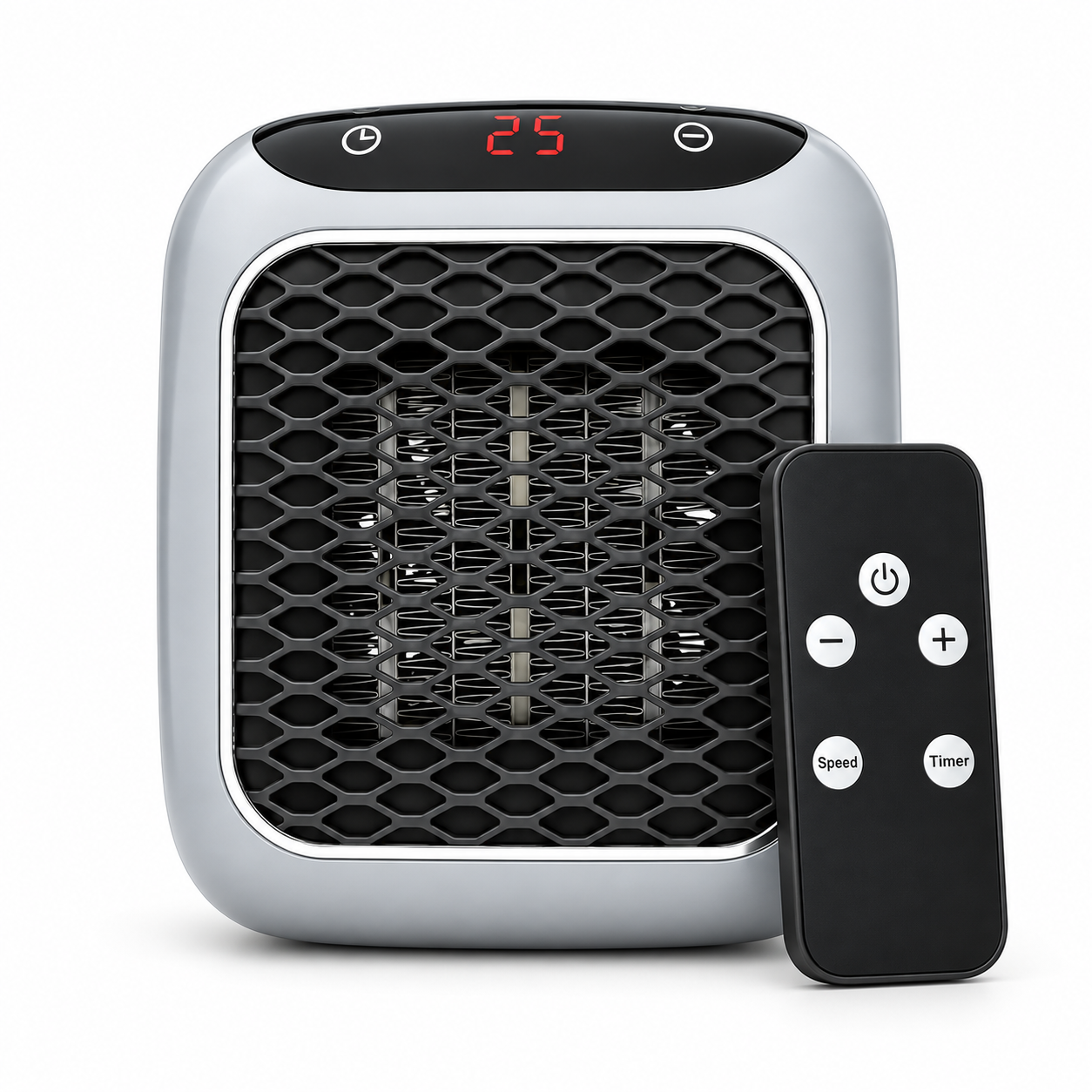
Recommended in this guide
If you choose to warm the room before bedtime
RapidHeat includes a thermostat, programmable timer, and overheat and tip-safe protection, so you can warm the nursery before bedtime and have it switch itself off automatically rather than relying on remembering to turn it off.
- Warm in ~60 seconds
- Under 30 dB
- Auto shut-off & timer
What we recommend against
We do not recommend leaving any space heater, RapidHeat included, running unattended overnight in a room with a sleeping infant. This is a conservative, deliberate recommendation rather than a legal disclaimer: a heater is a tool for warming a room before or after the time a baby is unattended in it, not a substitute for a properly insulated, appropriately heated home, and not something that should be relied on as a set-and-forget overnight solution next to a crib. If a nursery is consistently too cold overnight, that points to a larger issue — drafts, an old window, or a home heating system that is not reaching the room — worth solving directly. Our guide to a cold, drafty room covers cheap fixes that reduce how much extra heat any room needs in the first place.
General safety habits worth repeating
- Plug directly into a wall outlet, never an extension cord or power strip.
- Never drape clothing, blankets or anything flammable over or near the unit.
- Choose a model with a stated overheat cut-off and tip-over protection — see our full space heater safety guide for the complete list.
- Check smoke alarms in and near the nursery regularly, especially in colder months.
The National Fire Protection Association publishes general home heating safety guidance that is worth reviewing alongside your pediatrician's sleep-safety advice before adding any heater to a baby's room.
Common questions
What temperature should a baby's room be?
General guidance from pediatric and sleep-safety sources suggests a comfortably cool room, often cited around 68 to 72°F, is more comfortable for infant sleep than a warm room. This is general information, not medical advice — always follow your own pediatrician's guidance for your baby.
Is it safe to run a space heater in a nursery overnight?
Running any heater unattended overnight in a room with an infant is not something we recommend. If you use a heater to take the chill off a nursery, run it before bedtime with the door open, then turn it off, or use the timer so it switches off well before the baby is left unattended.
How far should a heater be from a crib?
At least three feet from the crib, bedding, curtains and anything flammable, as a minimum general safety clearance for any space heater. Ideally the heater warms the room from across the space rather than sitting close to the crib at all.
Should the heater's cord be a concern in a nursery?
Yes. Keep the cord fully out of reach of the crib and any area where a baby could crawl or pull on it, and never run it under a rug or across a walkway where it becomes a trip hazard.
Is a thermostat important for a nursery heater?
Very. A thermostat lets the heater hold a set temperature and switch off automatically once the room reaches it, rather than running continuously, which reduces both energy use and the chance of the room getting too warm.
What should I do instead of leaving a heater on all night in the nursery?
Warm the room before bedtime with the door closed to hold the heat, turn the heater off, and dress the baby appropriately for a cooler room overnight, following your pediatrician's sleep-safety guidance. A room thermometer helps you check the actual temperature rather than guessing.
Sources & how we got these numbers
- NFPA — Home Heating Safety — general heating equipment safety guidance
- Department of Energy — Small Space Heaters — general information on space heater types and safe use
- US Energy Information Administration — Electricity Monthly — average US residential electricity rate referenced site-wide
Costs are illustrative and calculated at the US average residential electricity rate. Your own rate, room and usage will change the result. See our editorial standards.
Keep reading
Ready to warm the room you're actually in?
Bundles start at $59 with free USA shipping and a 30-day money-back guarantee.
See bundles & order