Space Heater Cost to Run by State
The wattage never changes, but your electric bill does. Here is what a 1,500W heater actually costs where you live.
The short answer
RapidHeat from $59
Free USA shipping · 30-day money-back guarantee · Ships within 24 hours
The formula behind every number on this page
Every space heater's running cost comes down to one calculation: kilowatts x hours used x price per kilowatt-hour. RapidHeat and nearly every compact plug-in ceramic heater on the market draws about 1,500 watts on its high setting, which is 1.5 kW. Multiply 1.5 by the hours you run it, then multiply that by your electric rate in dollars per kWh. That is your cost, full stop — no brand changes this math, because a resistance heating element converts essentially all the electricity it draws into heat.
The US Energy Information Administration (EIA) tracks the average residential electricity price by state every month, and it is worth checking their published data directly since rates shift with fuel costs and seasons. For quick, illustrative math we use 17 cents per kWh, which is close to the recent national average residential rate — but your own state, and even your own utility company within a state, can be meaningfully higher or lower.
Approximate residential rates and the cost to run a 1,500W heater, state by state
The table below uses approximate average residential rates covering more than three dozen states plus the highest- and lowest-rate outliers. Treat these as ballpark figures for comparison, not your exact bill — rates change throughout the year and vary by utility. Always check your own bill for the number that actually applies to you. The "per month" column assumes 8 hours of use a day for 30 days, a reasonable estimate for regular evening and early-morning use in the coldest months.
| State | Region | Approx. rate (cents/kWh) | Cost per hour at 1.5 kW | Cost per 8-hour day | Cost per month (8 hrs/day) |
|---|---|---|---|---|---|
| Washington | Pacific | 11.5 | $0.17 | $1.38 | $41 |
| Idaho | Mountain | 11.6 | $0.17 | $1.39 | $42 |
| Utah | Mountain | 12.0 | $0.18 | $1.44 | $43 |
| Oklahoma | South Central | 12.5 | $0.19 | $1.50 | $45 |
| North Dakota | West North Central | 12.6 | $0.19 | $1.51 | $45 |
| Louisiana | South Central | 13.0 | $0.20 | $1.56 | $47 |
| Arkansas | South Central | 13.1 | $0.20 | $1.57 | $47 |
| Nebraska | West North Central | 13.2 | $0.20 | $1.58 | $48 |
| Missouri | West North Central | 13.4 | $0.20 | $1.61 | $48 |
| Kentucky | South Atlantic | 13.5 | $0.20 | $1.62 | $49 |
| Tennessee | South Atlantic | 13.6 | $0.20 | $1.63 | $49 |
| Mississippi | South Central | 13.8 | $0.21 | $1.66 | $50 |
| Alabama | South Atlantic | 14.1 | $0.21 | $1.69 | $51 |
| Wyoming | Mountain | 14.2 | $0.21 | $1.70 | $51 |
| Montana | Mountain | 14.3 | $0.21 | $1.72 | $51 |
| Kansas | West North Central | 14.4 | $0.22 | $1.73 | $52 |
| Florida | South Atlantic | 14.5 | $0.22 | $1.74 | $52 |
| South Carolina | South Atlantic | 14.6 | $0.22 | $1.75 | $53 |
| Iowa | West North Central | 14.8 | $0.22 | $1.78 | $53 |
| Indiana | East North Central | 15.0 | $0.23 | $1.80 | $54 |
| North Carolina | South Atlantic | 15.1 | $0.23 | $1.81 | $54 |
| Nevada | Mountain | 15.2 | $0.23 | $1.82 | $55 |
| Ohio | East North Central | 15.2 | $0.23 | $1.82 | $55 |
| Arizona | Mountain | 15.3 | $0.23 | $1.84 | $55 |
| Colorado | Mountain | 15.5 | $0.23 | $1.86 | $56 |
| Texas | South Central | 15.6 | $0.23 | $1.87 | $56 |
| Georgia | South Atlantic | 15.8 | $0.24 | $1.90 | $57 |
| Minnesota | West North Central | 15.9 | $0.24 | $1.91 | $57 |
| South Dakota | West North Central | 16.0 | $0.24 | $1.92 | $58 |
| Delaware | South Atlantic | 16.1 | $0.24 | $1.93 | $58 |
| West Virginia | South Atlantic | 16.2 | $0.24 | $1.94 | $58 |
| Virginia | South Atlantic | 16.3 | $0.24 | $1.96 | $59 |
| Pennsylvania | Mid-Atlantic | 16.4 | $0.25 | $1.97 | $59 |
| Wisconsin | East North Central | 16.5 | $0.25 | $1.98 | $59 |
| New Mexico | Mountain | 16.8 | $0.25 | $2.02 | $60 |
| Oregon | Pacific | 17.0 | $0.26 | $2.04 | $61 |
| Maryland | South Atlantic | 17.3 | $0.26 | $2.08 | $62 |
| Michigan | East North Central | 17.5 | $0.26 | $2.10 | $63 |
| Illinois | East North Central | 17.6 | $0.26 | $2.11 | $63 |
| New Jersey | Mid-Atlantic | 18.5 | $0.28 | $2.22 | $67 |
| Maine | New England | 21.0 | $0.32 | $2.52 | $76 |
| New York | Mid-Atlantic | 22.0 | $0.33 | $2.64 | $79 |
| New Hampshire | New England | 24.5 | $0.37 | $2.94 | $88 |
| Vermont | New England | 22.5 | $0.34 | $2.70 | $81 |
| Alaska | Pacific | 24.0 | $0.36 | $2.88 | $86 |
| Rhode Island | New England | 27.0 | $0.41 | $3.24 | $97 |
| Massachusetts | New England | 27.5 | $0.41 | $3.30 | $99 |
| Connecticut | New England | 28.0 | $0.42 | $3.36 | $101 |
| California | Pacific | 29.0 | $0.43 | $3.48 | $104 |
| Hawaii | Pacific | 41.0 | $0.61 | $4.92 | $148 |
Cheapest and most expensive states, in general terms
Rates tend to run lowest across parts of the Pacific Northwest, the Mountain West and the South, where a 1,500W heater can cost well under 20 cents an hour. New England states and Hawaii typically post the highest residential rates in the country, sometimes triple the national average, which means the exact same heater running the exact same number of hours costs three times as much there. This is purely a function of the local electricity market — it has nothing to do with the heater itself. For more general running-cost math, see our guide to what a space heater costs to run.
A closer look by region
Pacific Northwest and Mountain West
Washington, Idaho, Utah and Montana benefit from a mix of hydroelectric and lower-cost generation, which keeps rates near or below 15 cents/kWh. A household in this region running RapidHeat for 8 hours a day through a 5-month heating season (roughly 150 days) spends somewhere in the $85-$105 range in total electricity cost for that use pattern — noticeably less than the same routine in the Northeast.
South and South Central
States like Oklahoma, Arkansas, Louisiana and Tennessee post some of the lowest rates in the country, generally 12-14 cents/kWh. Winters here also tend to be shorter and milder, so total seasonal heating hours are often lower too, compounding the savings versus colder, higher-rate regions.
Midwest and Mid-Atlantic
Illinois, Michigan, Pennsylvania and New Jersey sit in a middle band, generally 16-18.5 cents/kWh. Combined with longer, colder winters than the South, households here often log more total heating hours even though the per-hour rate is only moderately higher, which raises the seasonal total more than the rate alone suggests.
New England, New York and Hawaii
Connecticut, Massachusetts, Rhode Island, New Hampshire, Vermont, New York and Hawaii post the highest residential rates in the country, often 21-41 cents/kWh. In these states the same 8-hour daily habit that costs roughly $60/month in a low-rate state can cost $130-$200/month, which is exactly why heating only the occupied room, rather than the whole house, matters most in these regions.
Recommended in this guide
The compact heater this guide keeps coming back to
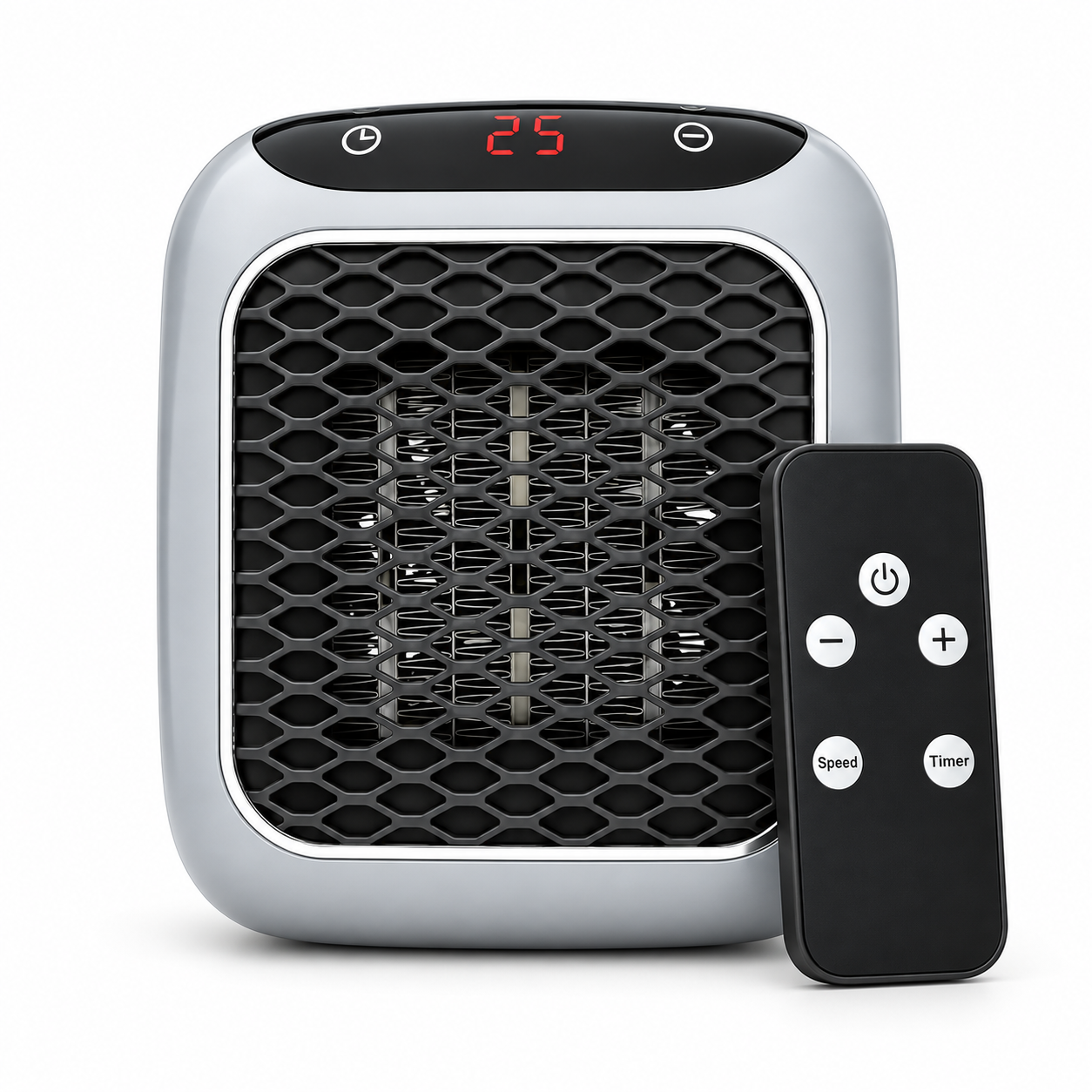
RapidHeat is a hand-sized ceramic heater that plugs straight into a wall outlet, pushes out warm air in about a minute and switches itself off on a timer. It is built for warming one room properly, not a whole house.
- Warm in ~60 seconds
- Under 30 dB
- Auto shut-off & timer
Seasonal totals: what a full winter actually costs
A single evening's cost looks small, but it is worth totaling across a heating season. Assume 8 hours a day, roughly 150 days (about 5 months, October through February) of regular use — a realistic pattern for someone using a space heater to warm a bedroom or office rather than running a furnace all day.
| Rate band | Example states | Cost per hour | Cost per 150-day season (8 hrs/day) |
|---|---|---|---|
| ~12 cents/kWh | Oklahoma, Idaho, Arkansas | $0.18 | ≈ $216 |
| ~15-16 cents/kWh | Ohio, Texas, Colorado | $0.23-$0.24 | ≈ $276-$288 |
| ~17-18.5 cents/kWh | Illinois, Michigan, New Jersey | $0.26-$0.28 | ≈ $315-$333 |
| ~22-29 cents/kWh | New York, Massachusetts, California | $0.33-$0.44 | ≈ $396-$522 |
Even at the high end, a full season of daily space-heater use in a high-rate state is typically far less than the cost of raising the thermostat for an entire home over the same period, especially in a house or apartment with more than one or two occupied rooms.
Finding your exact rate
Skip the estimates and use your own number: pull out your latest electric bill and look for a line item showing cents per kilowatt-hour, sometimes labeled "energy charge" or "supply rate." If your bill only shows a total dollar amount, divide that by the total kWh used that period to back into your effective rate. Many utilities also publish current residential rate schedules on their websites. Once you have your rate, plug it into the energy savings calculator for a number specific to your home and habits.
“I run the heater in my home office in Ohio for about four hours a day instead of heating the whole house. My electric bill barely moved.”
Why heating one room usually wins regardless of your state's rate
Whatever your state's rate is, the bigger lever is how much space you heat, not the heater's wattage. A central furnace or heat pump conditions your entire home; a space heater like RapidHeat conditions the one room you are sitting in. Even in a higher-rate state, running a 1,500W heater in a bedroom for a few hours in the evening typically costs less than raising the thermostat for the whole house over the same period. See how the two approaches compare directly in space heater vs. central heating.
Choosing the right size heater for your room
Running cost only tells half the story — the other half is whether the heater is sized correctly for the room. An undersized heater running constantly at full power to keep up with a large space actually costs more over time than a correctly sized unit cycling on a thermostat. Check our guide on what size space heater you need before assuming a bigger unit is always better value.
Practical ways to lower the number, wherever you live
Behavior changes that cost nothing
- Use the thermostat instead of running on high constantly.
- Set a timer instead of leaving it on all night or all day.
- Heat only the room you are in, and close the door to hold the heat there.
- Check for drafts around windows and doors, which force any heater to work harder.
- Lower the target temperature by even 1-2 degrees; each degree meaningfully reduces run time.
Setup changes that pay off over a season
- Weatherstrip doors and windows in the room you heat most.
- Use draft stoppers at the base of doors leading to unheated hallways.
- Position the heater where airflow reaches you directly rather than behind furniture that blocks it, so it does not need to run as long to feel warm.
- Compare the 1, 2 and 3-pack bundle pricing if you plan to heat more than one room, since running two correctly sized heaters briefly is often cheaper than one heater working overtime to reach a larger space.
Common questions
How much does it cost to run a space heater for 8 hours?
At the US average residential rate of about 17 cents per kWh, a 1,500W heater running flat out for 8 hours uses 12 kWh, which costs roughly $2.04. A thermostat cycles the element on and off, so real-world cost is usually lower.
Which states have the cheapest electricity for running a heater?
States with lower residential rates, often in the Pacific Northwest and parts of the South and Mountain West, tend to have cheaper per-hour costs. Rates change often, so check your own utility bill for the exact figure.
Which states have the most expensive electricity?
States in New England and Hawaii typically post some of the highest residential electricity rates in the country, which roughly doubles or triples the per-hour cost of running any heater compared with lower-rate states.
How do I find my exact electricity rate?
Look at your latest electric bill for a rate expressed in cents per kilowatt-hour, or divide your total bill amount by your total kWh used. Utility websites also publish current rates by rate plan.
Does a space heater use more electricity than central heating?
It depends what you are heating. A space heater used to warm one occupied room instead of running a whole-house furnace or heat pump often costs less overall, because you are heating far less space.
Does RapidHeat use more power than other heaters?
No. RapidHeat is a roughly 1,500W class ceramic heater, in line with nearly all compact plug-in space heaters sold in the US. The cost per hour is essentially the same as any other heater at that wattage.
How many hours a day does a typical household run a space heater?
Most customers report 4 to 8 hours a day during the coldest months, concentrated in the morning and evening when a room is occupied. Using the timer instead of running it continuously keeps the daily total on the lower end of that range.
Is a space heater cheaper to run than an electric blanket or oil-filled radiator?
An electric blanket draws far less wattage (often under 100W) and costs a fraction as much per hour, but only warms a bed, not a room. An oil-filled radiator typically draws similar wattage to RapidHeat but takes longer to warm up, so hour-for-hour costs are close, with RapidHeat reaching comfortable air faster.
Why buy direct from RapidHeat US
- Official US store — the same team that handles warranty claims
- Free shipping from a US warehouse, dispatched within 24 hours
- 30-day money-back guarantee and a 12-month warranty
- US-based email and phone support, not a marketplace reseller
Sources & how we got these numbers
- EIA Electric Power Monthly — source for state and national average residential electricity rates
- Energy.gov: Small Space Heaters — guidance on space heater efficiency and use
Costs are illustrative and calculated at the US average residential electricity rate. Your own rate, room and usage will change the result. See our editorial standards.
Keep reading
Ready to warm the room you're actually in?
Bundles start at $59 with free USA shipping and a 30-day money-back guarantee.
See bundles & order