Are Space Heaters Safe?
Modern electric heaters are safe when used correctly. Almost every incident traces back to the same handful of avoidable mistakes.
The three-foot rule
Keep three feet of empty space around a running heater in every direction. Bedding, curtains, laundry drying on a chair, stacks of paper, a sofa arm — the fire risk is almost never the heater itself failing, it is something flammable being too close to it.
Plug it straight into the wall
No extension cords. No power strips. No smart plugs or mechanical timer plugs unless they are explicitly rated for a 1,500 watt heater. A heater pulls around 12.5 amps continuously and light-gauge cords are not built for that. If the only outlet is across the room, move the heater, not the power.
Safety features worth having
- Overheat protection: cuts power if internal temperature rises too far, for example when the air intake is blocked.
- Tip-over or tip-safe design: shuts off or prevents operation if the unit is knocked over.
- Cool-touch housing: matters in any home with children or pets.
- Programmable timer: the simplest way to avoid an unattended heater running for hours.
- Thermostat: stops the unit running at full power indefinitely.
Overnight use, honestly
A heater with all of the features above, correctly placed, is designed for extended running. But the safest overnight setup is a timer set for the hour or two it takes to fall asleep, a closed door to hold the heat, and a working smoke alarm in the room. Never put a heater on a bed, a nightstand or anything soft.
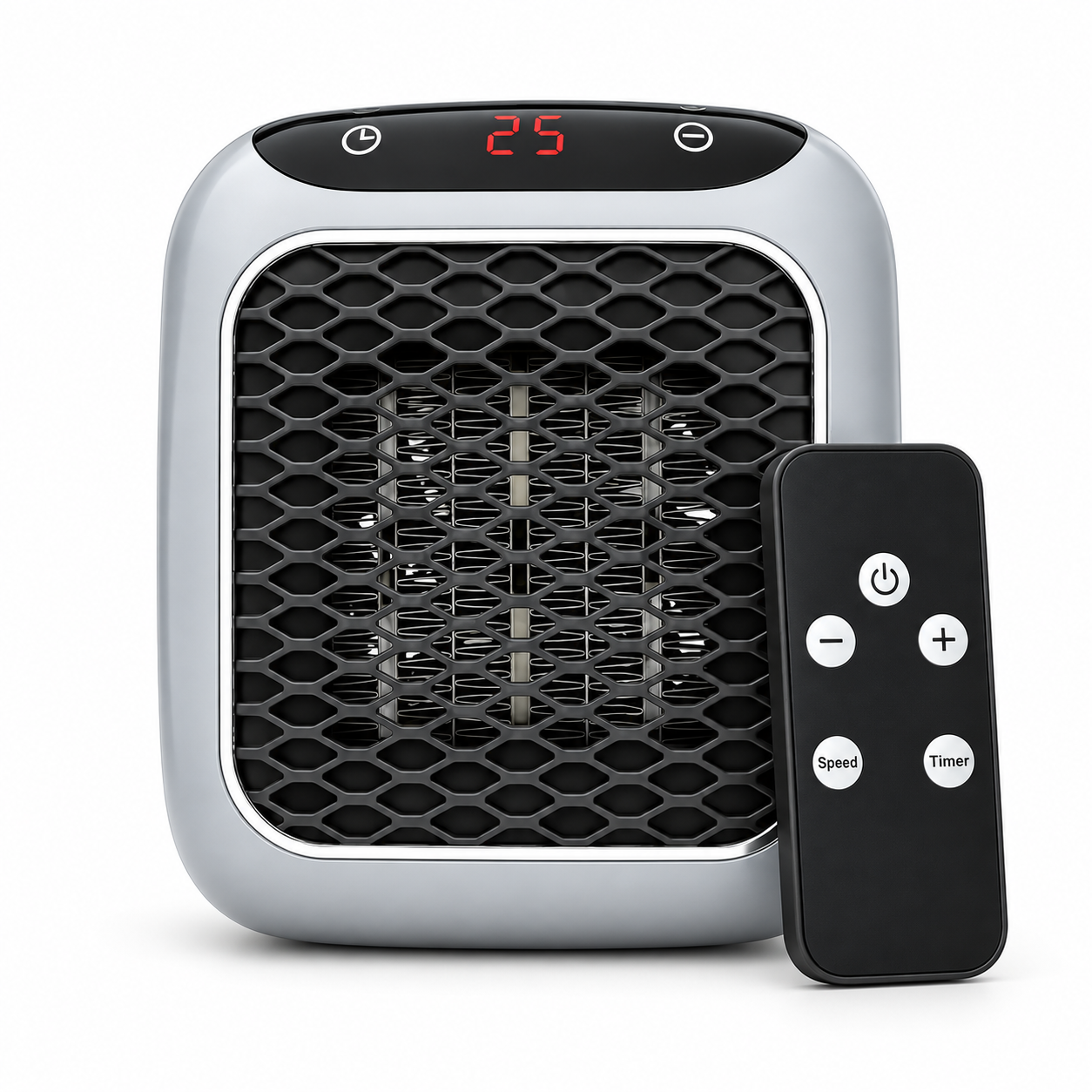
Recommended in this guide
The compact heater this guide keeps coming back to
RapidHeat is a hand-sized ceramic heater that plugs straight into a wall outlet, pushes out warm air in about a minute and switches itself off on a timer. It is built for warming one room properly, not a whole house.
- Warm in ~60 seconds
- Under 30 dB
- Auto shut-off & timer
Children, pets and placement
- Put the unit where a cord cannot be tripped over or chewed
- Hard flat surface only — not deep carpet that blocks the base intake, not a stack of books
- Never in a bathroom unless the unit is specifically rated for damp locations
- Never used to dry clothes, shoes or towels
Electric heaters and carbon monoxide
An electric heater burns nothing, so it emits no carbon monoxide. That is a real hazard with kerosene, propane and gas heaters, and a reason many people choose electric for indoor and RV use. What electric heaters can do is dry the air, so if your throat feels dry, a small humidifier alongside helps.
Warning signs to stop using a heater
- A burning smell after the first 20 minutes of the very first use
- The plug or outlet feeling hot to the touch
- Repeated breaker trips
- A damaged, frayed or discolored cord
- The unit shutting off repeatedly for no clear reason
How RapidHeat is built for this
RapidHeat includes overheat protection with automatic shut-off, a tip-safe cool-touch housing, flame-retardant materials and a programmable timer, and it plugs directly into a standard 120V US outlet. Setup details are in the user manual.
Common questions
Are space heaters safe to leave on overnight?
A modern heater with overheat protection, tip-over protection and a timer, plugged directly into a wall outlet with three feet of clearance, is designed for this. The safest habit is still to use the timer so it switches itself off rather than running until morning.
Can a space heater cause carbon monoxide poisoning?
An electric space heater cannot. It has no combustion, so it produces no carbon monoxide. That risk applies to fuel-burning heaters such as kerosene and propane units.
Why can't I use an extension cord with a space heater?
Heaters draw high sustained current. Most extension cords and power strips are not rated for it, which causes the cord to overheat. This is one of the most common causes of heater-related fires and it is entirely avoidable.
Keep reading
Ready to warm the room you're actually in?
Bundles start at $59 with free USA shipping and a 30-day money-back guarantee.
See bundles & order