Energy Efficient Space Heaters: What Actually Saves Money
Marketing loves the word efficient. Physics has a different opinion. Here is where real savings come from.
The short answer
RapidHeat from $59
Free USA shipping · 30-day return window · Published store policies
The uncomfortable fact first
Every plug-in electric heater — ceramic, oil-filled, infrared, fan — converts virtually all the electricity it draws into heat. A 1,500 watt heater from any brand produces the same 1,500 watts of heat. There is no magic element that produces more heat per watt of electricity, and any product claiming otherwise is describing something that does not exist in basic physics. This is different from combustion appliances or heat pumps, where efficiency ratings mean something real.
Practical efficiency, by heater type
| Heater type | Watts-to-heat ratio | Warm-up speed | Practical efficiency factor |
|---|---|---|---|
| Ceramic (PTC) convection | ~100% | Typically quick; varies by model | Useful for short, occupied-room sessions |
| Oil-filled radiator | ~100% | Slow, 15-20 minutes | Lower — holds heat after shut-off but slow to respond |
| Infrared panel | ~100% | Instant, but heats objects not air | Good for a fixed spot; wastes energy if you move around |
| Fan heater (no ceramic element) | ~100% | Fast | High but often louder and shorter lifespan |
| Whole-home heat pump | 200-300%+ | Gradual | Highest per-watt, but a different tool for whole-house heating |
"Watts-to-heat ratio" is the share of electrical input converted directly to heat at the unit. All resistance heaters land near 100%; a heat pump can exceed 100% because it moves ambient heat rather than generating it from resistance.
So where do savings actually come from?
- Zone heating. Heating one 120 square foot room instead of a 1,800 square foot house is where the big number comes from. This is the single biggest lever.
- Time. A thermostat that cycles the element off once the room is warm can halve the hours it actually draws power.
- A timer. Two hours instead of eight is a 75% reduction, no technology required.
- Turning the central thermostat down. The saving only exists if the furnace does less work. Running both at full tilt costs more, not less.
- Sealing the room. Closing the door and blocking the draft underneath is free and makes everything else work better.
- Right-sizing the unit. An undersized heater runs constantly and never catches up; an oversized one overshoots and wastes the excess. See what size space heater do I need.
Key takeaway
Worked example: the cost of "efficiency" claims
Say a household runs a 1,500W heater for 4 hours a day in one bedroom, with a thermostat holding a 50% duty cycle: that's 6 kWh × 0.5 = 3 kWh/day, or about $0.51/day and roughly $15.30/month at $0.17/kWh. Heating the same house's five rooms with central heating for those same 4 hours, in a typical older home, often costs several times that because you are paying to warm rooms nobody occupies. The "up to 90% savings" claims you see in ads are really this zone-heating comparison — not a claim about the heater's internal efficiency. Verify the specific numbers for your own home with the running cost calculator.
How to read efficiency claims
When you see "up to 90% less energy," what is being compared is running one small heater versus running whole-house heating — not one heater versus another heater. That comparison can be true for your household or not, depending on the size of your home, your rate and how you use it. Put your own numbers into the calculator rather than trusting anyone's headline.
Recommended in this guide
The compact heater this guide keeps coming back to
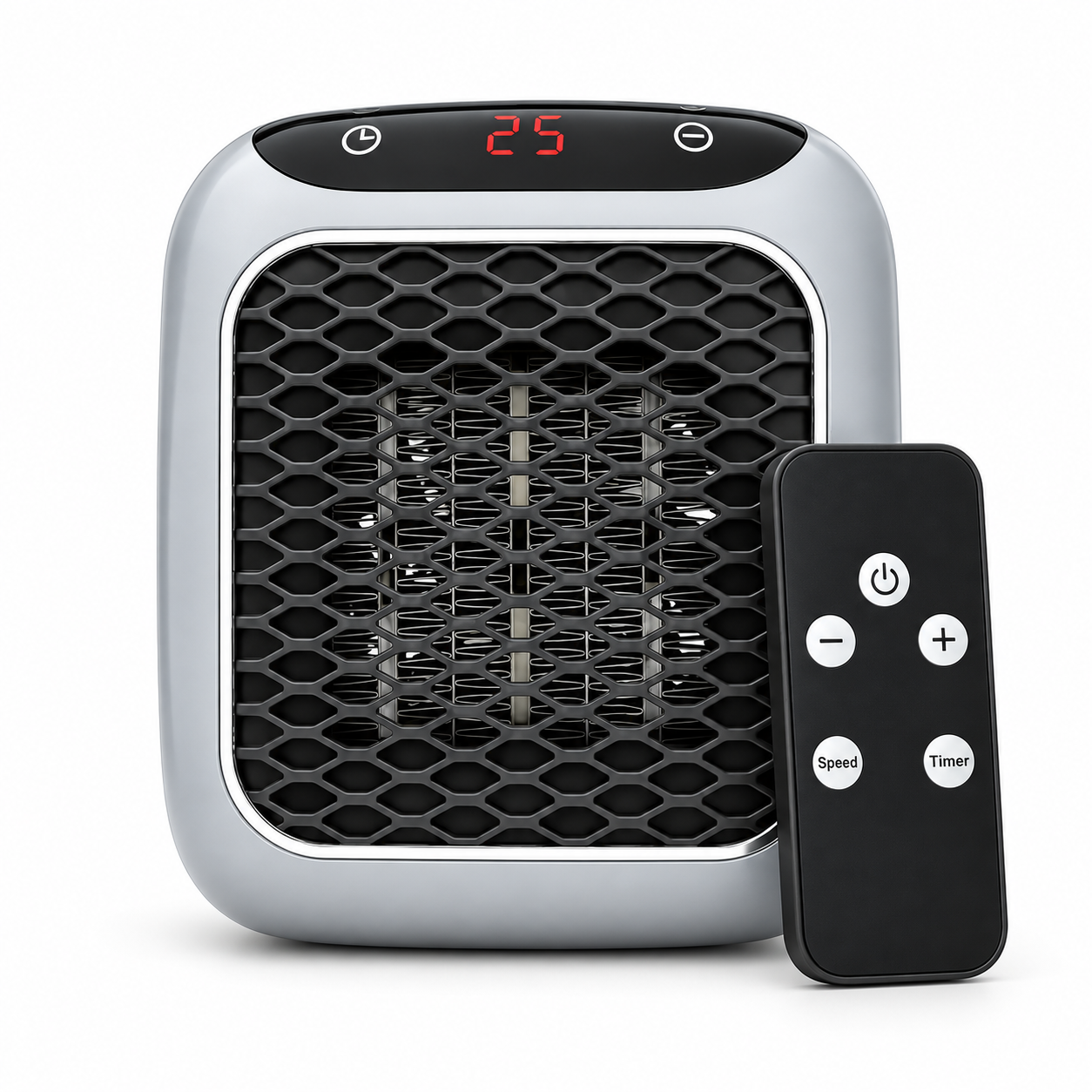
RapidHeat is a portable ceramic fan heater for personal and supplemental room heating. Room results depend on insulation, drafts, ceiling height and starting temperature; it is not a whole-home heating replacement.
- Ceramic fan heating
- Remote control included
- Programmable timer
What to look for
- An accurate thermostat with degree-level setting, not just high and low
- A programmable auto shut-off timer
- Fast warm-up, so you are not running it for 20 minutes waiting for anything to happen
- A remote, because a heater you actually adjust is a heater that runs less
- Multiple heat levels so you can run low when low is enough
What to avoid
- Any marketing claim that one heater's element is "more efficient" than another's
- Heaters with only high/low switches and no true thermostat
- Oversizing "to be safe" — it wastes energy overshooting the room
Where does a heat pump fit into this?
Heat pumps are genuinely more efficient in the technical sense, often delivering 2-3+ units of heat per unit of electricity because they move heat rather than generate it from resistance. They are whole-home systems, though, with a much higher upfront cost and installation requirement. A plug-in space heater solves a different, smaller problem: warming the one room you're using right now, for the cost of a wall outlet and no installation. See space heater vs central heating for when each approach makes sense.
Where RapidHeat fits
RapidHeat has the features that create real savings: fast ceramic warm-up, a thermostat that holds temperature, a programmable timer and a remote, in a unit sized for a single room. See bundle pricing.
Common questions
Which space heater uses the least electricity?
The one with the lowest wattage that still keeps you comfortable, controlled by an accurate thermostat and a timer. A 1,500 watt heater that cycles off half the time uses less than a 900 watt heater running continuously.
Are ceramic heaters more energy efficient than other types?
All electric resistance heaters convert essentially 100% of the electricity they draw into heat, so no type is meaningfully more efficient than another at the plug. Ceramic units feel efficient because they warm up fast and hold temperature well with a thermostat, so they spend less time running.
Do space heaters save money versus central heating?
They can, when you heat one or two occupied rooms and turn the central thermostat down. They cost more when used in addition to full central heating, or when trying to heat many rooms at once.
Is a heat pump more efficient than a space heater?
Yes, in terms of heat delivered per watt — a heat pump moves existing heat rather than generating it, so it can produce more than one unit of heat per unit of electricity. A whole-home heat pump and a small plug-in space heater solve different problems: one heats a house, the other heats a room you're actually in.
Does turning a space heater to a lower wattage setting save money?
Usually yes, as long as the lower setting still keeps you comfortable — you are drawing fewer watts per hour. If it forces the unit to run much longer to reach the same comfort, the saving shrinks.
Why buy direct from RapidHeat US
- Official US store — the same team that handles warranty claims
- Free shipping to eligible US delivery addresses
- 30-day return window and a 12-month limited warranty
- US-based email and phone support, not a marketplace reseller
Sources & how we got these numbers
- Department of Energy — Small Space Heaters — guidance on zone heating, thermostats and sizing
- US Energy Information Administration — Electric Power Monthly — residential electricity rate data
Costs are illustrative and calculated at the US average residential electricity rate. Your own rate, room and usage will change the result. See our editorial standards.
Keep reading
Ready to warm the room you're actually in?
Bundles start at $59 with free eligible US shipping and a 30-day return window.
See bundles & order