Best Space Heater for a Bedroom
A bedroom heater has a harder job than any other room: it has to be warm, silent and safe enough to sit beside you for eight hours.
The short answer
RapidHeat from $59
Free USA shipping · 30-day return window · Published store policies
The five things that actually matter in a bedroom
- Noise. Anything above a soft hum will wake light sleepers. Look for a stated decibel figure, not just the word "quiet." See our decibel comparison guide for what the numbers actually mean in a bedroom.
- A real thermostat. Without one the room swings between stuffy and cold all night. A thermostat cycles the element and holds a steady temperature.
- A timer. Set it for the one or two hours it takes to fall asleep rather than running the heater until morning.
- Safety cut-offs. Overheat protection and a tip-safe housing are non-negotiable next to a bed. Read more in our safety guide.
- A dim or off display. A bright blue panel in a dark bedroom is a genuine annoyance for anyone sensitive to light while sleeping.
Which heating type suits a bedroom
Not every heater technology behaves the same way overnight. Here is how the common types compare specifically for bedroom use:
| Heater type | Noise | Warm-up speed | Bedroom verdict |
|---|---|---|---|
| Ceramic (PTC) | Varies by model; verify published test data | Typically quick; varies by model | Useful for directed supplemental heat |
| Oil-filled radiator | Silent, no fan | 15–30 minutes | Good if warmed before bed |
| Infrared panel | Near-silent | Instant on skin, slow on air | Fine for a chair, weak overnight |
| Basic fan heater | 50+ dB | Fast but uneven | Avoid — loud, usually no thermostat |
Key takeaway
Sizing your bedroom: a full table
Use about 10 watts per square foot for a reasonably insulated room with a standard 8 foot ceiling. Multiply length by width to get square footage, then multiply by 10.
| Bedroom size | Square feet | Recommended wattage | Units |
|---|---|---|---|
| Small / kids room (9x10) | 90 | ~900 W | 1 |
| Standard bedroom (10x12) | 120 | ~1,200 W | 1 |
| Large bedroom (12x14) | 168 | ~1,500–1,700 W | 1 |
| Primary bedroom w/ sitting area (14x18) | 252 | ~2,500 W | 2 |
| Large primary suite (16x20+) | 320+ | ~3,200 W | 2 |
A large primary bedroom with high ceilings or a lot of glass may want two units placed on opposite sides of the room rather than one oversized heater — see what size heater you need for the full adjustment rules.
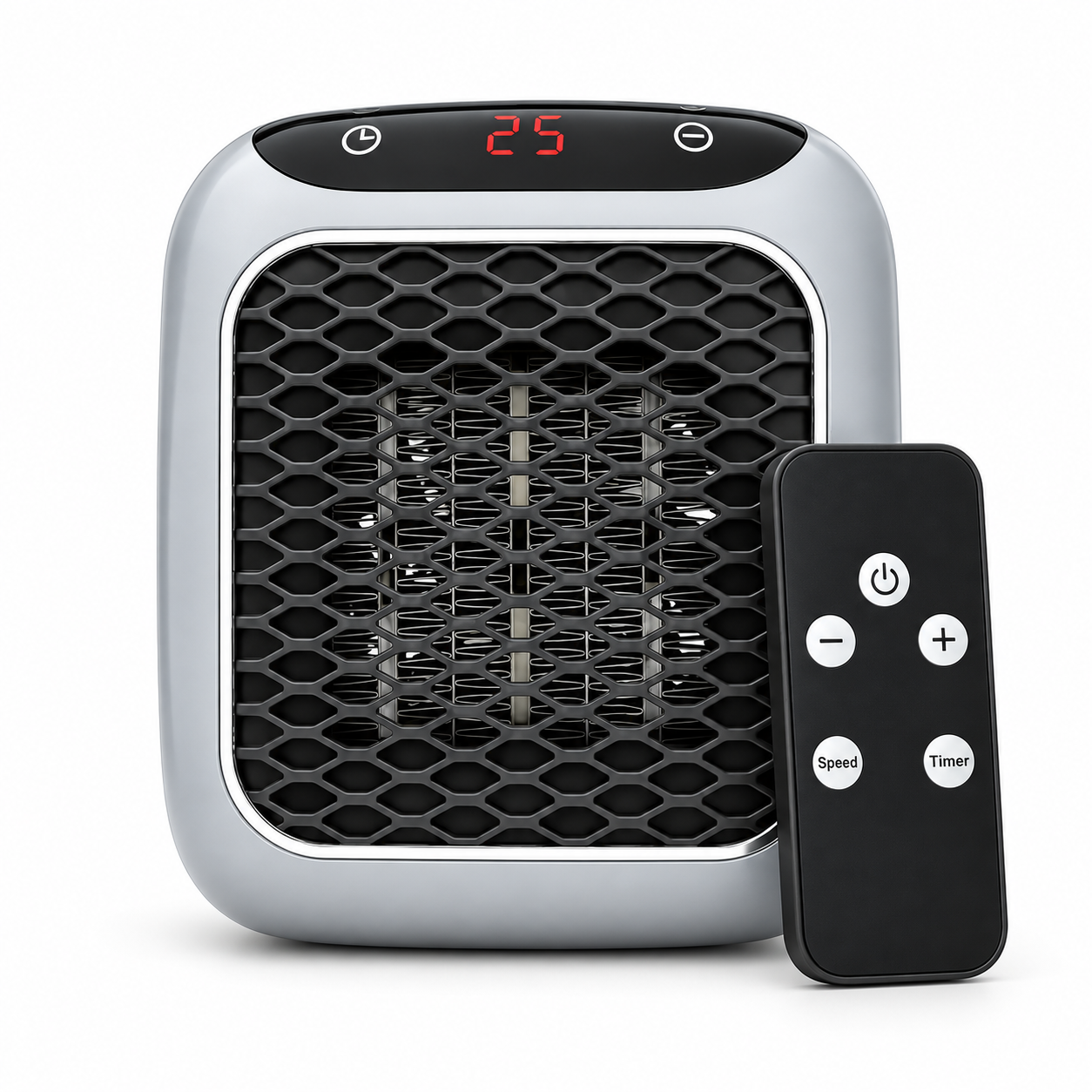
Recommended in this guide
The compact heater this guide keeps coming back to
RapidHeat is a portable ceramic fan heater for personal and supplemental room heating. Room results depend on insulation, drafts, ceiling height and starting temperature; it is not a whole-home heating replacement.
- Ceramic fan heating
- Remote control included
- Programmable timer
Worked example: a 12x14 ft bedroom overnight
Take a common large bedroom, 12 feet by 14 feet, which is 168 square feet. At 10 watts per square foot that calls for roughly 1,680 watts, which rounds to a single 1,500 to 1,700 watt ceramic heater running near its top setting, or a 1,500 watt unit if the room is well insulated with newer windows.
Running that 1,500 watt heater flat out for 8 hours uses 12 kWh. At the US average residential rate of about $0.17 per kWh (illustrative — check your own utility bill for your exact rate), that is roughly $2.04 for a full night at full power. In practice a thermostat cycles the element on and off once the room reaches temperature, so real overnight draw is often 40 to 60% of that, closer to $0.80–$1.20. Using the timer for two hours instead of eight, so the room is warm at bedtime and the heater switches off once you are asleep, brings a typical night down to around $0.35–$0.50. You can plug in your own room size, wattage and local rate at the running cost calculator.
Placement that works, and placement that doesn't
- Plug directly into a wall outlet — never an extension cord or power strip.
- Keep three feet of clearance from the bed, curtains, laundry piles and anything paper.
- Stand it on a hard, flat surface — not deep carpet pile that blocks the base intake, and not a nightstand it can fall from.
- Angle the airflow across the room rather than directly at sleeping skin.
- Use the timer so it switches itself off after you are asleep.
What to look for, and what to avoid
| Look for | Avoid |
|---|---|
| A stated decibel rating around 30 dB or lower | Vague "whisper quiet" marketing with no number |
| A dial or digital thermostat with degree control | High/low only switch with no thermostat |
| Overheat protection and tip-over shut-off | No listed safety cut-offs at all |
| Programmable timer and a remote for bedside use | Coil or exposed-element heaters near bedding |
| A cool-touch housing safe for kids' or pets' curiosity | Units that must sit on an extension cord to reach the outlet |
Check your bedroom smoke alarm works, especially heading into heating season, and review the full rundown in are space heaters safe.
Where RapidHeat fits
RapidHeat is a portable ceramic fan heater with a programmable timer and remote control. We do not publish verified noise, warm-up or room-coverage figures, so evaluate it using your room conditions and the instructions supplied with the unit. See current bundle pricing.
Common questions
Is it safe to run a space heater in a bedroom overnight?
It is, provided the heater has overheat protection, tip-over protection and a timer, is plugged directly into a wall outlet, and sits at least three feet from bedding and curtains. Using the timer rather than leaving it running all night is the safest habit.
What is the quietest type of heater for a bedroom?
A ceramic heater with a low fan speed setting or an oil-filled radiator. Oil-filled units are silent but slow; a good ceramic heater runs around 30 dB, which is quieter than a whisper-level conversation.
What size heater does a bedroom need?
Roughly 10 watts per square foot. A typical 120 to 150 square foot bedroom is well served by a compact heater in the 1,200 to 1,500 watt class.
Should I run the heater all night or use the timer?
Most people are more comfortable, and safer, setting the timer for one to two hours — long enough to fall asleep in a warm room. A thermostat-controlled unit left running all night is not dangerous by itself, but a timer reduces both risk and cost.
Where should the heater sit in a bedroom?
On the floor on a hard, flat surface, at least three feet from the bed, curtains and any fabric, and positioned so the cord is not a trip hazard. Never on a nightstand it could be knocked from.
Will a bedroom heater dry out the air?
Electric resistance heaters, ceramic included, do not remove moisture from the air the way a furnace duct system can feel like it does. If your bedroom already feels dry in winter, a small humidifier alongside the heater addresses that separately.
Why buy direct from RapidHeat US
- Official US store — the same team that handles warranty claims
- Free shipping to eligible US delivery addresses
- 30-day return window and a 12-month limited warranty
- US-based email and phone support, not a marketplace reseller
Sources & how we got these numbers
- U.S. Energy Information Administration — Electric Power Monthly — Source for the average US residential electricity rate used in cost estimates.
- Department of Energy — Small Space Heaters — Guidance on sizing and safe use of portable space heaters.
- National Fire Protection Association — Home Heating Safety — Clearance and placement recommendations referenced above.
Costs are illustrative and calculated at the US average residential electricity rate. Your own rate, room and usage will change the result. See our editorial standards.
Keep reading
Ready to warm the room you're actually in?
Bundles start at $59 with free eligible US shipping and a 30-day return window.
See bundles & order