Space Heater in a Cold, Drafty Room
If a heater runs constantly and the room never quite feels warm, the heater usually is not the problem — the room is losing heat as fast as it makes it.
The short answer
Why some rooms just will not warm up
Every room loses heat continuously through its windows, walls, floor and any gaps in construction. Heating engineers describe this in terms of air changes per hour — roughly how many times the entire volume of air in a room is replaced by outside air in an hour. A tight, well-sealed room might exchange air less than once an hour. An old house with single-pane windows, an ill-fitting door and gaps around baseboards can exchange air several times an hour, which means a heater is effectively trying to warm a room that keeps refilling with cold outside air. No wattage fixes that on its own; the leak has to be addressed first.
The usual suspects
| Draft source | How to check | Typical fix | Rough cost |
|---|---|---|---|
| Single-pane or old windows | Hold a hand near the glass and frame on a cold day | Removable window insulation film or a draft snake on the sill | $5-$20 |
| Gap under exterior/room door | Look for daylight under the door | Door sweep or a fabric draft stopper | $8-$20 |
| Loose door/window frame gaps | Feel around the frame edges | Peel-and-stick foam weatherstripping | $6-$15 |
| Cold, uninsulated or slab floor | Bare feet feel noticeably colder than room air | Area rug or thick mat | $20-$80 |
| Electrical outlets on exterior walls | Feel for airflow around the outlet plate | Foam outlet gaskets | $5-$10 |
| Uninsulated exterior wall | Wall feels cold to the touch, not just the air | Heavy curtains on that wall; longer-term, insulation upgrade | $20+ (curtains); more for insulation work |
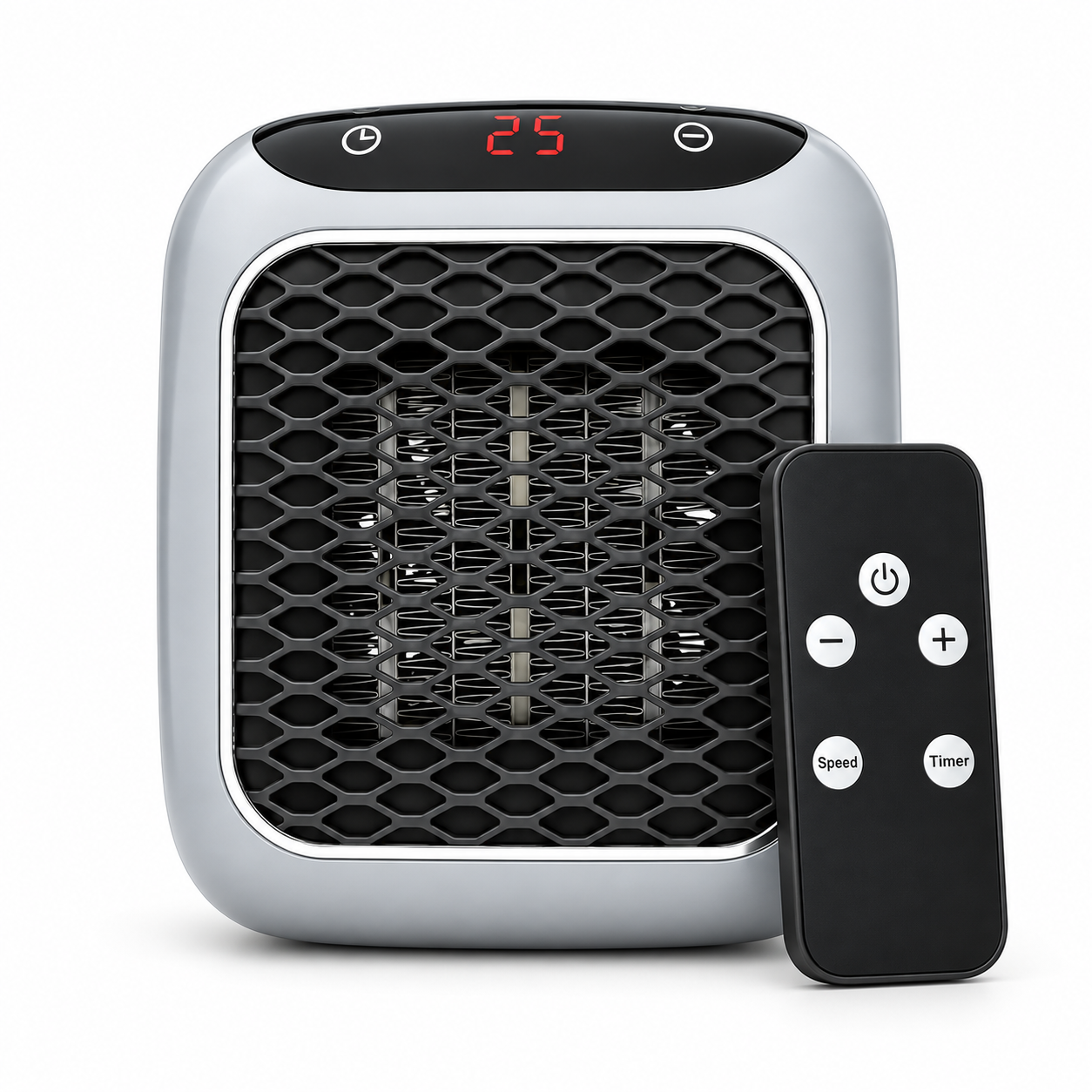
Recommended in this guide
The compact heater this guide keeps coming back to
RapidHeat is a hand-sized ceramic heater that plugs straight into a wall outlet, pushes out warm air in about a minute and switches itself off on a timer. It is built for warming one room properly, not a whole house.
- Warm in ~60 seconds
- Under 30 dB
- Auto shut-off & timer
What a plug-in heater can realistically do
A compact heater in the 1,500-watt class, like RapidHeat, is designed to heat a single occupied room of up to roughly 130 square feet, not to overcome a house's worth of uninsulated walls. In a reasonably sealed room it will get warm air moving within about 60 seconds and bring the room to a comfortable temperature within several minutes. In a genuinely drafty room, the same heater will run more, cost more to operate, and still struggle to hold a stable temperature — which is exactly why sealing drafts first changes the outcome so much. Use the heater sizing guide to check whether your room and heater are even a reasonable match before assuming the room itself is the problem.
“Sealed the bottom of an old exterior door with a draft stopper and put window film on one drafty window — the same heater we already had suddenly kept the room warm all evening instead of running constantly.”
Positioning the heater for a drafty room
- Place it a few feet from where you actually sit, not tucked in a far corner.
- Keep it away from the draft source itself — putting a heater right next to a leaky window means much of its output is being pulled straight back outside.
- Stand it on a hard, flat, stable surface with the three feet of clearance from furniture and curtains described in our safety guide.
- Close the door to the rest of the house so the heater is working with less air.
- Let the thermostat, not constant maximum output, hold the temperature once the room starts to warm — see the built-in controls in our how it works page.
A simple checklist before you buy a bigger heater
- Feel for drafts around every window, door and outlet on an exterior wall.
- Add a door sweep or draft stopper to any door with visible daylight underneath.
- Apply window film or a draft snake to the coldest window in the room.
- Add a rug over any bare, cold floor.
- Close the door to isolate the room, then run the heater and reassess after 20 minutes.
Most of these fixes cost less than a single month of extra heating from running a bigger, more powerful heater to compensate for the same leaks. If the room is still cold after sealing the obvious gaps, it may simply be larger than one compact heater is built for — see our guide to heating a large room.
Common questions
Why does my room stay cold even with a space heater running?
Usually because heated air is escaping as fast as the heater produces it, through drafts around windows and doors, gaps at the floor, or a poorly insulated wall. A heater fights a losing battle in a leaky room no matter how powerful it is.
Can a space heater fix a drafty room on its own?
Not fully. A heater adds heat, but it cannot stop that heat from escaping. Sealing obvious drafts first, then running the heater, gets a far warmer room per dollar than the heater alone.
Where should I put a space heater in a drafty room?
Away from the draft source itself, ideally where it can push warm air toward the area you actually sit in, and never directly in front of a door or window where cold air is entering. Central placement, a few feet from where you sit, generally works better than a corner.
What is the cheapest fix for a drafty window?
Removable window insulation film or a draft snake along the sill, both a few dollars, seal most of the air leakage from an old single-pane window without any tools or professional install.
Does closing the door to a drafty room help?
Yes, significantly. Closing the door stops warm air from escaping into the rest of the house and stops cold air from other rooms mixing back in, so the heater is working with a much smaller, more sealed volume of air.
Will a bigger heater fix a drafty room faster?
A bigger heater can offset some heat loss, but it also costs more to run and does nothing about the underlying leak. Sealing drafts first is almost always cheaper than buying a larger heater.
Sources & how we got these numbers
- Department of Energy — Small Space Heaters — guidance on efficient space heater use and room sealing
- NFPA — Home Heating Safety — safe placement guidance referenced above
- US Energy Information Administration — Electricity Monthly — average US residential electricity price used elsewhere on this site
Costs are illustrative and calculated at the US average residential electricity rate. Your own rate, room and usage will change the result. See our editorial standards.
Keep reading
Ready to warm the room you're actually in?
Bundles start at $59 with free USA shipping and a 30-day money-back guarantee.
See bundles & order