Best Space Heater for a Home Office
Working in a cold room is miserable and it shows in your output. Here is how to pick a heater that warms your desk without humming through every call.
The short answer
RapidHeat from $59
Free USA shipping · 30-day return window · Published store policies
The office-specific problems
- You are on camera and on calls. Fan noise is picked up by laptop microphones far more than people expect. See our decibel guide for what different noise levels sound like on a call.
- It runs all day. Eight hours a day means the thermostat matters more than raw output — a unit with no thermostat will overheat the room by mid-morning.
- Circuit load. Monitors, a computer and a 1,500 watt heater on one circuit is how breakers trip. Give the heater its own wall outlet.
- Desk space is finite. A footprint the size of a shoebox that sits on the floor beats a tower you have to work around.
Circuit sharing: the math that matters
A standard US home-office circuit is rated 15 or 20 amps at 120V, giving roughly 1,800 or 2,400 watts of headroom before a breaker trips — and code recommends staying at 80% of that for continuous loads. A 1,500 watt heater alone draws about 12.5 amps, which already uses most of a 15 amp circuit. A monitor, a desktop tower, a printer and a heater on the same strip is a common way home offices trip breakers in winter. Plug the heater into a different wall outlet than your computer equipment wherever possible.
| Circuit type | Safe continuous load | 1,500 W heater alone | Heater + desktop + monitors |
|---|---|---|---|
| 15 amp / 120V | ~1,440 W | Fits, little headroom left | Likely trips |
| 20 amp / 120V | ~1,920 W | Fits comfortably | Tight but often fine |
Sizing a home office: full table
Most home offices, spare bedrooms and converted box rooms fall between 80 and 200 square feet. Use roughly 10 watts per square foot as your starting point.
| Office size | Square feet | Recommended wattage | Units |
|---|---|---|---|
| Small nook / closet office (8x10) | 80 | ~800 W | 1 |
| Standard home office (10x14) | 140 | ~1,400 W | 1 |
| Larger converted room (12x15) | 180 | ~1,800 W | 1 on its own circuit, or 2 units |
| Open cubicle bay (per desk zone) | 60–100 | ~600–1,000 W | 1 small unit per person, where policy allows |
Larger converted garages or double rooms used as offices need more; see heating a large room.
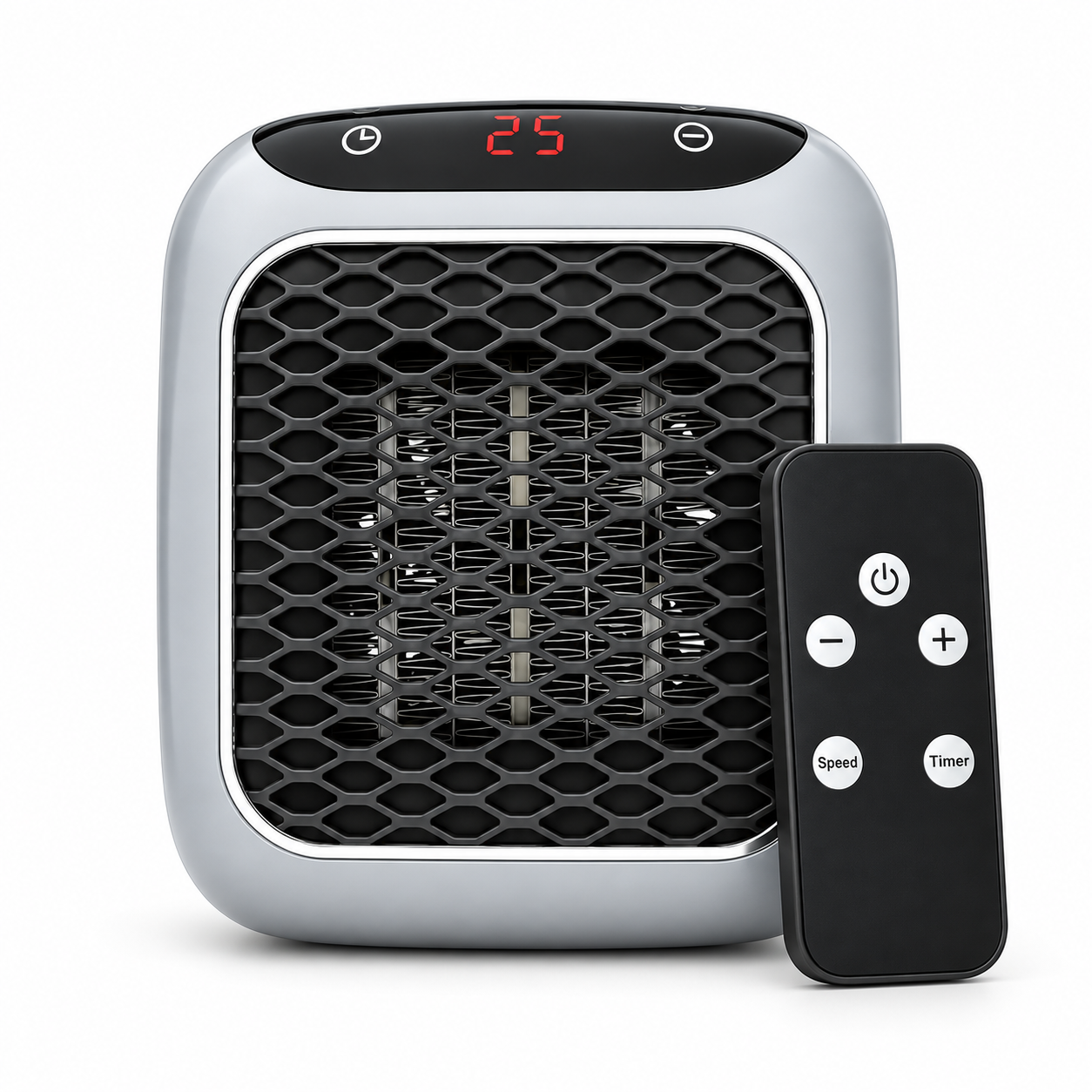
Recommended in this guide
The compact heater this guide keeps coming back to
RapidHeat is a portable ceramic fan heater for personal and supplemental room heating. Room results depend on insulation, drafts, ceiling height and starting temperature; it is not a whole-home heating replacement.
- Ceramic fan heating
- Remote control included
- Programmable timer
Worked example: a 180 sq ft office across an 8-hour workday
Take a 12x15 foot home office, 180 square feet. At 10 watts per square foot that is about 1,800 watts of demand, which in practice means either a single 1,500 to 1,800 watt heater on a dedicated circuit or two 1,000-1,200 watt units placed on opposite sides of the room to avoid overloading one outlet.
Running a 1,500 watt heater for a full 8-hour workday at full draw uses 12 kWh, which at the US average residential rate of about $0.17 per kWh (illustrative — your own rate will vary) works out to roughly $2.04 for the day. A thermostat-controlled unit in a closed office door typically cycles off for a third to half of that time once the room is warm, bringing a realistic workday closer to $1.00–$1.40. Compare that with running central heating for an entire empty house from 9 to 5 just so one room stays warm. Estimate your own numbers, including your local rate, in the running cost calculator.
Placement that actually works
- Put it on the floor, slightly to one side of your chair, blowing across your legs rather than directly at them.
- Do not tuck it in the footwell against a desk panel — trapped air makes the overheat cut-off trigger unnecessarily.
- Keep cables, paper and a waste basket well clear.
- Close the office door. You are heating one room, not the hallway.
What to look for, and what to avoid
| Look for | Avoid |
|---|---|
| A stated noise rating near 30 dB for calls | No published decibel figure at all |
| A remote so you are not crawling under the desk | Units that require unplugging to change settings |
| A dedicated wall outlet, separate from your PC setup | Sharing a power strip with monitors and a desktop |
| Overheat protection and cool-touch housing near your legs | Exposed coil elements at floor level |
| Company policy allowing personal heaters | Plugging one in without checking facilities rules first |
Where RapidHeat fits
RapidHeat is a portable ceramic fan heater with a timer and remote. Because we do not publish a verified decibel or warm-up figure, shoppers who need strict meeting-room noise limits should compare independently measured results. See current bundle pricing.
Common questions
Are space heaters allowed in offices?
Many workplaces restrict them because of circuit load and fire policy. Check with your facilities team first. Where they are allowed, a compact thermostat-controlled ceramic unit plugged directly into a wall outlet is normally the accepted type.
Will a space heater trip an office circuit?
It can if several heaters or a heater plus other equipment share one circuit. A 1,500 watt heater draws about 12.5 amps, which is most of a standard 15 amp circuit on its own. Never run one on a power strip with computers or monitors.
What heater is quiet enough for video calls?
Look for a ceramic heater rated around 30 dB on its low setting. At that level a laptop microphone with noise suppression will not pick it up from a few feet away.
Can I use a space heater in a cubicle?
Usually, if your employer allows personal heaters at all, since a cubicle is a small enclosed footprint similar to a compact bedroom. Confirm the building's policy, keep clearance from paper and fabric partitions, and never leave it running unattended overnight.
How do I stop the heater from overheating under a desk?
Give it open air on at least two sides, do not wedge it against a solid desk panel, and keep it off carpet with a deep pile that can block the base intake. Overheat protection will shut the unit down safely if airflow is blocked, but good placement avoids nuisance shut-offs.
Is it cheaper to heat one office or the whole building?
Heating a single occupied room with a small electric heater is almost always cheaper than raising the temperature of an entire building or house for one person, which is the core reason personal heaters remain popular for remote and hybrid workers.
Why buy direct from RapidHeat US
- Official US store — the same team that handles warranty claims
- Free shipping to eligible US delivery addresses
- 30-day return window and a 12-month limited warranty
- US-based email and phone support, not a marketplace reseller
Sources & how we got these numbers
- U.S. Energy Information Administration — Electric Power Monthly — Source for the average US residential electricity rate used in cost estimates.
- Department of Energy — Small Space Heaters — Guidance on sizing and safe use of portable heaters for occupied rooms.
- National Fire Protection Association — Home Heating Safety — Clearance, cord and placement guidance referenced above.
Costs are illustrative and calculated at the US average residential electricity rate. Your own rate, room and usage will change the result. See our editorial standards.
Keep reading
Ready to warm the room you're actually in?
Bundles start at $59 with free eligible US shipping and a 30-day return window.
See bundles & order