Is RapidHeat Safe to Use?
A straightforward look at the safety features built into RapidHeat, the rules that apply to any space heater, and what it should never be used for.
The short answer
RapidHeat from $59
Free USA shipping · 30-day money-back guarantee · Ships within 24 hours
What safety features RapidHeat actually has
RapidHeat is built with the core safety features that matter on any compact electric heater. An internal overheat sensor shuts the unit down automatically if the ceramic element or housing runs hotter than it should, and it will not restart until it has cooled back down. A tip-over switch cuts power the instant the unit is no longer sitting upright, so if it gets knocked over it stops heating rather than continuing to run on its side. The outer housing is designed to stay cool to the touch during normal operation, which matters if it is anywhere near curious hands or paws. None of this replaces common sense placement and supervision, but it is the baseline every household heater should have.
The 3-foot rule, visualized
Picture the heater sitting in the middle of an imaginary circle with a 3-foot radius — about the length of a golf club laid on the floor in every direction. Nothing should cross into that circle: no curtain hem, no bed skirt, no stack of magazines, no phone charging cable draped over the top, no pet bed pushed up next to it. A simple way to check a new spot is to stand the heater where you plan to use it, then physically walk the circle around it before switching it on. This single rule prevents the large majority of home heater fires, according to fire safety guidance from organizations like the NFPA, and it applies to every space heater on the market, not just this one.
Good placement vs. bad placement, in plain terms
- Good: On the floor against an open wall, facing into the room, at least 3 feet from the bed, desk chair path, and any fabric.
- Good: On a hard-surfaced side table too heavy to tip, away from foot traffic, cord running straight to the nearest outlet with no slack for anyone to trip on.
- Bad: Tucked under a desk where a cord, bag or fabric could brush the housing.
- Bad: On a rug or carpet pile, on a windowsill near curtains, or angled toward a couch arm or bedding.
Always a wall outlet, never a cord or strip
RapidHeat should be plugged directly into a wall outlet. Extension cords and power strips are usually not rated for the sustained 12+ amp draw of a 1,500W heater, and running one through a lightweight cord is one of the most common causes of overheated wiring and melted plugs in the industry generally. If the outlet you want to use is far from where you want the heater, move the heater closer to the outlet, not the other way around.
A quick outlet check before you plug in
Before running any space heater regularly on an outlet, look for these warning signs: discoloration or a burnt smell around the outlet or plug, a plug that feels loose or falls out easily, an outlet cover that is cracked, or a breaker that has tripped before on that circuit. Any of these means the outlet or wiring should be inspected by a licensed electrician before you rely on it for a heater. A healthy outlet should hold the plug snugly and stay at room temperature to the touch after an hour of use.
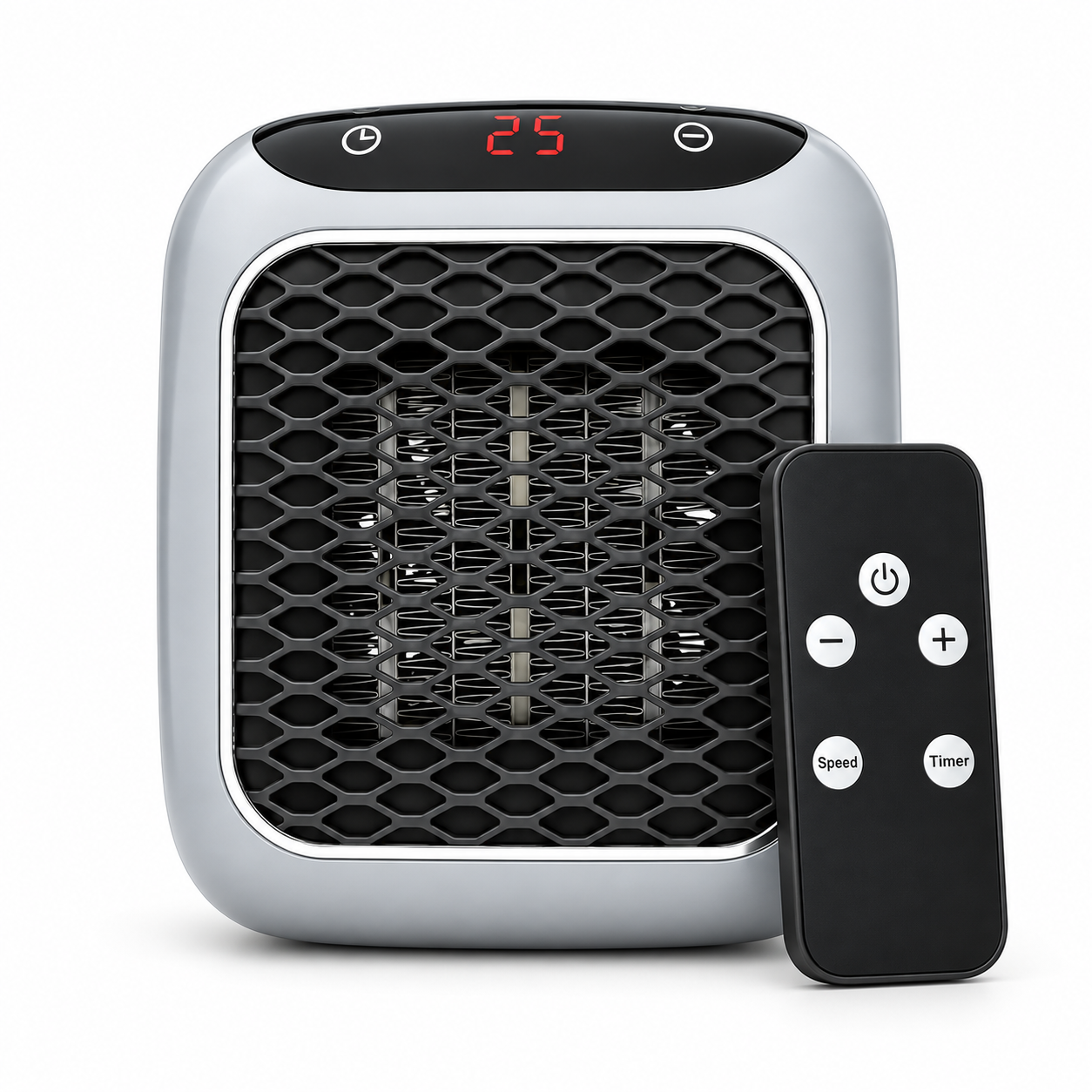
Recommended in this guide
The compact heater this guide keeps coming back to
RapidHeat is a hand-sized ceramic heater that plugs straight into a wall outlet, pushes out warm air in about a minute and switches itself off on a timer. It is built for warming one room properly, not a whole house.
- Warm in ~60 seconds
- Under 30 dB
- Auto shut-off & timer
What a 1,500W heater does to your circuit
At 120 volts, a 1,500W heater draws about 12.5 amps. A standard US household circuit is rated for 15 amps, so RapidHeat alone uses roughly 80% of that circuit's capacity. That is normal and by design, but it means you should avoid running other high-draw appliances — a hair dryer, a toaster, a window AC unit — on the same circuit and outlet at the same time, or you risk tripping the breaker.
| Circuit rating | Typical heater draw | Safe to add another high-draw device? |
|---|---|---|
| 15A / 120V | ~12.5A at 1,500W | No — leaves little headroom |
| 20A / 120V | ~12.5A at 1,500W | Small appliances only, with care |
To find out what else is on the same circuit, run RapidHeat on high and then turn on other devices in the same room or nearby rooms one at a time. If the breaker trips, you now know which outlets share a circuit, and you can plan not to run them together. Kitchens, bathrooms and laundry rooms are the most common places where multiple high-draw appliances accidentally end up on one circuit.
Do this / avoid this
| Do | Avoid |
|---|---|
| Plug directly into a wall outlet | Using an extension cord or power strip |
| Place on a hard, flat, stable surface | Placing on carpet, a bed, or an uneven surface |
| Keep a 3-foot clearance on all sides | Letting curtains, bedding or cords drape near it |
| Use the timer for overnight or unattended rooms | Leaving it running indefinitely with no one home |
| Turn off and unplug when leaving the room for a while | Assuming the safety features remove the need to check on it |
| Keep it out of reach of kids and pets | Placing it where a toddler or dog can reach or knock it |
Overnight and bedroom use
RapidHeat can be used overnight, but treat it deliberately: place it on a hard flat surface, keep the three-foot clearance from the bed and curtains, and use the timer so it switches off after you fall asleep rather than running for eight uninterrupted hours. A working smoke alarm in the room is good practice with any heater. For more on this specific scenario, see our guide to the best space heater for a bedroom, and general safety guidance at are space heaters safe.
“I was nervous about running any heater near my toddler's crib, but the auto shut-off and cool housing put me at ease. We use the timer every night.”
Kids and pets
Keep RapidHeat out of reach of small children and pets, and never treat the tip-over switch or overheat sensor as a substitute for supervision. A determined toddler or an excited dog can still knock a heater around before the safety features fully engage. Position it where it cannot be pulled, batted or chewed, and unplug it if you leave the room for a long stretch. If you have a crawling infant or a cat that jumps onto furniture, consider placing the heater on the floor against a wall behind a piece of furniture that blocks direct access while still allowing airflow into the room.
When not to use RapidHeat
- Bathrooms or near water. Do not use it anywhere it could get splashed or where humidity is high. Electric heating elements and water do not mix.
- Unattended in a garage with fuel or chemicals present. Any space heater near stored gasoline, propane or solvents is a fire risk regardless of its safety features.
- Drying clothes or draping fabric over it. Never rest laundry, towels or any fabric on or near the heater to dry it faster — this defeats the clearance rule entirely.
- As a substitute for central heating in extreme cold. It is built to warm one room, not to replace a furnace during a hard freeze.
- On an outlet or circuit already carrying a heavy load. If the outlet is already powering another high-draw appliance, or the wiring shows any warning signs, choose a different outlet or have it checked first.
- In a room with no one able to check on it. Overnight or unattended use should always pair the timer with a smoke alarm in the room, whatever heater brand you use.
For a broader look at usage in tricky spaces, see RV and garage space heater use. For overall running costs alongside safety, see what a space heater costs to run.
Common questions
Does RapidHeat have overheat protection?
Yes. RapidHeat has a built-in overheat sensor that automatically shuts the unit off if its internal temperature climbs too high, and it will not restart until it has cooled.
What happens if RapidHeat tips over?
RapidHeat has tip-over protection that cuts power the moment the unit is no longer sitting upright on a flat surface. This is a standard safety feature on all reputable space heaters, and RapidHeat should always be placed on a stable, flat, hard surface to work as intended.
Is it safe to run RapidHeat while I sleep?
It can be used overnight if it is on a hard flat surface, plugged directly into a wall outlet, at least three feet from bedding and curtains, and ideally set on the timer rather than left running indefinitely. A working smoke alarm in the room is always a good idea regardless of heater brand.
Can I plug RapidHeat into an extension cord or power strip?
No. Like any 1,500W-class heater, RapidHeat should be plugged directly into a wall outlet. Extension cords and power strips are not rated for the sustained current a heater draws and can overheat.
Is RapidHeat safe around kids and pets?
The housing stays cool to the touch and the base is designed to resist tipping, which helps in homes with kids or pets, but no space heater should be left unsupervised around small children or curious animals. Keep it out of reach and behind a stable barrier if needed.
Will RapidHeat trip my breaker?
A 1,500W heater draws about 12.5 amps on a 120V circuit, which is a significant share of a standard 15-amp circuit. Avoid running other high-draw appliances on the same circuit at the same time.
Can I use RapidHeat in a bathroom?
We do not recommend using RapidHeat, or any plug-in electric heater, in a bathroom or anywhere it could contact water or high humidity. Water and electric heating elements are a dangerous combination.
How do I know if my outlet can handle RapidHeat?
A standard grounded 15-amp or 20-amp household outlet in good condition, not shared with another high-draw appliance, is sufficient. If the outlet, cover plate or plug feels warm after use, or the outlet is old, loose or has visible scorch marks, stop using it and have an electrician inspect the wiring before plugging in any heater.
Why buy direct from RapidHeat US
- Official US store — the same team that handles warranty claims
- Free shipping from a US warehouse, dispatched within 24 hours
- 30-day money-back guarantee and a 12-month warranty
- US-based email and phone support, not a marketplace reseller
Sources & how we got these numbers
- NFPA: Home Heating Safety — the 3-foot rule and general heater fire safety guidance
- Energy.gov: Small Space Heaters — safe use and placement guidance for plug-in heaters
Costs are illustrative and calculated at the US average residential electricity rate. Your own rate, room and usage will change the result. See our editorial standards.
Keep reading
Ready to warm the room you're actually in?
Bundles start at $59 with free USA shipping and a 30-day money-back guarantee.
See bundles & order