Space Heater vs Central Heating
Not a rivalry — a division of labor. The savings depend entirely on how many rooms you need warm and whether the central thermostat actually goes down.
The short answer
RapidHeat from $59
Free USA shipping · 30-day return window · Published store policies
The core idea: zone heating
Central heating warms every room whether or not anyone is in it. Zone heating warms the room with the people in it. If you are alone in a home office from 9 to 5, or the family is in one living room all evening, you are paying to heat a lot of empty space with central heating. That gap is the entire saving a space heater can capture.
Cost comparison table
| Scenario | Approach | Typical monthly cost (illustrative) |
|---|---|---|
| One person, one room, 4 hrs/day | 1,500W space heater + lower thermostat | ~$15-$30 |
| One person, one room, 4 hrs/day | Central heating, whole house, unchanged setpoint | Often $60-$150+ |
| Family, 3+ rooms occupied evenings | Multiple space heaters | Can exceed central heating cost |
| Family, 3+ rooms occupied evenings | Central heating with modest setback | Usually cheaper overall |
Central heating figures vary enormously by fuel type, house size and insulation — treat these as illustrative ranges, not a quote for your home.
When a space heater wins
- One person home during the day working in one room
- One room that is always colder than the rest of the house
- Evenings spent entirely in one living room
- Shoulder season, when you want one warm room rather than firing up the furnace
- You want warmth for an hour rather than a whole-house heating cycle
When central heating wins
- The whole family is home and using several rooms at once
- You need every room, including hallways and bathrooms, above a certain temperature
- Very cold weather where pipe protection matters
- You have gas heating and a high electricity rate — the fuel cost difference can outweigh the zone advantage
House types matter
An older home with distinct, closable rooms captures the zone-heating advantage well: close the door, and the warm air stays put. Open-concept layouts and studio apartments lose much of that advantage because warm air mixes freely with the rest of the space — though in a small enough studio, the whole unit effectively becomes the "one room" you're heating anyway, which still often beats a furnace cycling for a single occupant. See best space heater for an apartment for that specific case.
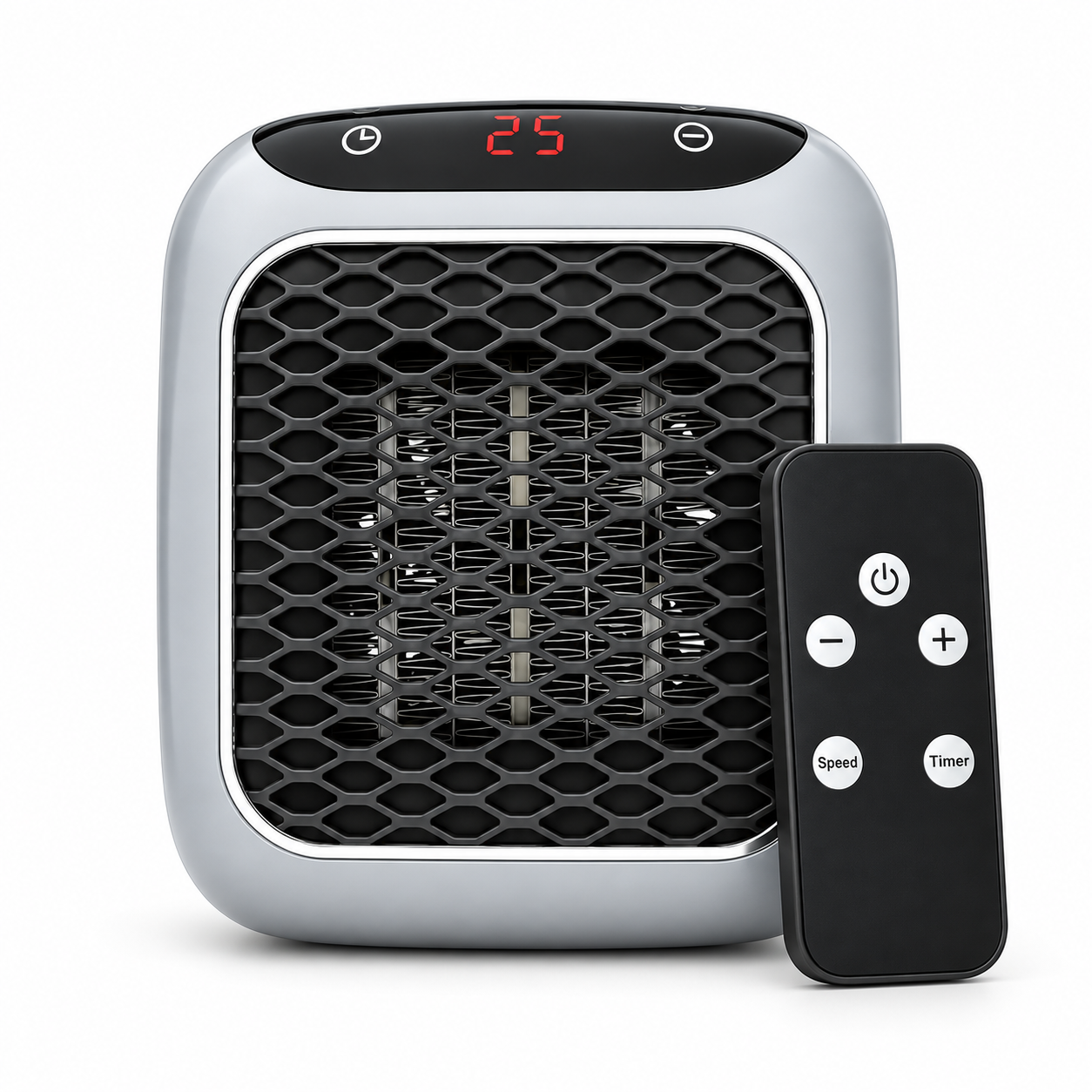
Recommended in this guide
The compact heater this guide keeps coming back to
RapidHeat is a portable ceramic fan heater for personal and supplemental room heating. Room results depend on insulation, drafts, ceiling height and starting temperature; it is not a whole-home heating replacement.
- Ceramic fan heating
- Remote control included
- Programmable timer
The mistake that erases the saving
Running a space heater while leaving the central thermostat exactly where it was. You have now added a 1,500 watt appliance to your bill and removed nothing. The saving only exists if the furnace does less work. Drop the central setting a few degrees and let the space heater make up the difference where you actually are.
Thermostat setback strategy
The Department of Energy recommends setting your thermostat back 7-10°F for 8 hours a day (for example, while you're in one heated room, or overnight) as a well-established way to cut heating costs — roughly 10% a year for that setback alone. Pair that setback with a space heater in the room you occupy during those hours, and the two savings stack: less central heating load, plus the comfort you'd otherwise lose from the setback.
Worked example: 2-person household
A two-person household spends evenings, roughly 4 hours, in the living room, and sleeps with bedroom doors closed. They set the central thermostat back from 70°F to 63°F during those evening hours and run a 1,500W heater in the living room instead. At a 50% duty cycle, that's 3 kWh/evening × 30 days = 90 kWh, about $15.30/month at $0.17/kWh. Their furnace runs less because it's covering a lower setpoint for those hours across the rest of the house. Most households in this scenario report the combined bill is lower than running the furnace at a constant 70°F all evening — though the exact savings depend on insulation, fuel type and local climate, which is why checking your own bill after a month matters more than any generic estimate.
Key takeaway
Comfort, not just cost
Cost aside, some people simply prefer the immediacy of a space heater — warm air in about a minute in the exact spot they're sitting, versus waiting for a furnace cycle to reach a distant room. That comfort factor is legitimate even when the dollar difference is small.
Gas versus electric matters
If your central heating runs on natural gas, gas is usually cheaper per unit of heat than electricity, which narrows the advantage of an electric space heater. The zone effect can still win, because you are heating a tenth of the volume — but the margin is smaller than it is for homes with electric or heat-pump central heating and high whole-house losses.
How to combine both properly
- Set the central thermostat to a lower baseline that protects the house
- Put a heater in the one or two rooms you genuinely use
- Close doors to the rooms you are heating
- Use the heater's timer rather than leaving it running
- Check your bill after one month and adjust — real data beats any article
Common questions
Is it cheaper to use a space heater than central heating?
It is cheaper when you heat one or two occupied rooms and lower the central thermostat. It is more expensive when the space heater runs in addition to full central heating, or when you need several rooms warm at once.
Should I turn off my furnace and just use space heaters?
No. Turning central heating off completely risks frozen pipes and cold damage. The recommended approach is to lower the central thermostat to a safe baseline and use a space heater in the room you occupy.
How many rooms can I heat with space heaters before central heating is cheaper?
As a rule of thumb, once you are heating three or more rooms simultaneously, central heating generally becomes the more sensible option for most US homes.
How much can thermostat setback actually save?
The Department of Energy notes that turning a thermostat back 7-10 degrees for 8 hours a day can save around 10% a year on heating, before even adding a space heater in the occupied room. Combined with zone heating, the two strategies stack.
Does house type change the answer?
Yes. Open-concept homes lose the zone-heating advantage because heat and cold air mix freely between rooms. Homes with closable doors and distinct rooms, like older houses with a traditional room layout, see the biggest space-heater savings.
Why buy direct from RapidHeat US
- Official US store — the same team that handles warranty claims
- Free shipping to eligible US delivery addresses
- 30-day return window and a 12-month limited warranty
- US-based email and phone support, not a marketplace reseller
Sources & how we got these numbers
- Department of Energy — Small Space Heaters — zone heating and thermostat setback guidance
- US Energy Information Administration — Electric Power Monthly — residential electricity rate data
Costs are illustrative and calculated at the US average residential electricity rate. Your own rate, room and usage will change the result. See our editorial standards.
Keep reading
Ready to warm the room you're actually in?
Bundles start at $59 with free eligible US shipping and a 30-day return window.
See bundles & order