How RapidHeat Works
A plain-English explanation of ceramic PTC heating, fan-driven airflow, thermostat cycling and safe setup.
The short answer
RapidHeat from $59
Free USA shipping · 30-day return window · Published store policies
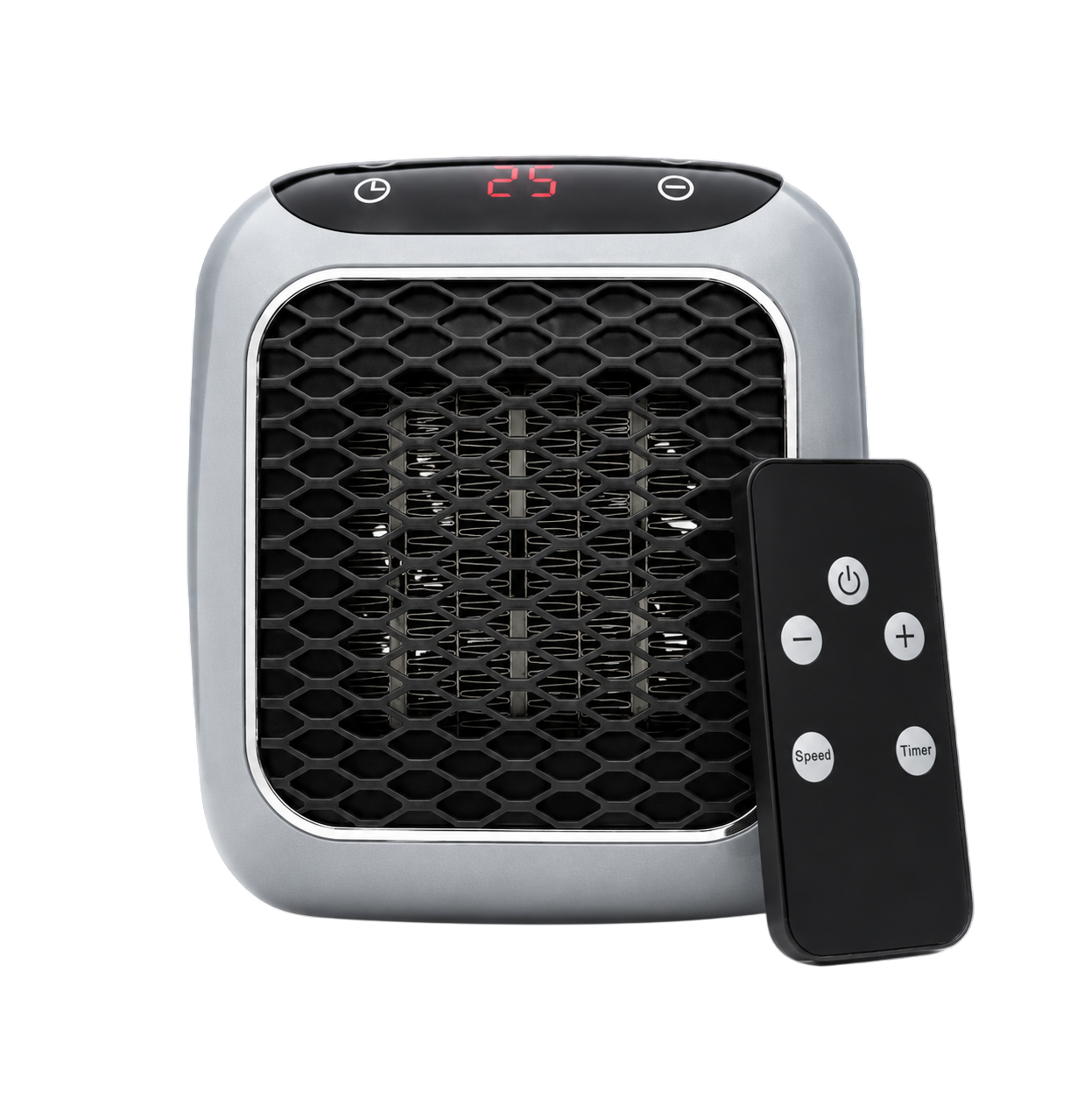
The heating path
How electricity becomes warm airflow
- 1. PowerA standard wall outlet supplies electricity.
- 2. Ceramic heatThe PTC element converts it into heat.
- 3. AirflowA fan moves room air across the element.
- 4. TemperatureThe thermostat responds to your setting.
How does PTC ceramic heating work?
Inside RapidHeat is a stack of ceramic PTC plates. PTC stands for positive temperature coefficient, which is a technical way of saying the ceramic's electrical resistance rises as it gets hotter. That characteristic helps moderate the element's heat output, but it does not replace the heater's thermostat, shutoffs or safe-use instructions. Electricity passes through the ceramic, and a fan pulls room air across the warm element and pushes it back into the room.
Because the ceramic element and moving air have less thermal mass to warm than an oil-filled radiator, a ceramic fan heater can deliver directed warm airflow sooner. That does not mean the entire room reaches the chosen temperature in one minute; whole-room warming depends on the room and conditions.
Key takeaway
What should you notice during startup?
At startup
The fan begins moving air after power-on.
As it warms
Air at the front outlet should become noticeably warmer.
As heating continues
You may feel directed warmth nearby; the room still needs time.
How the heat feels compared with other heater types
| Heater type | What you feel first | Best-known characteristic |
|---|---|---|
| Ceramic fan heater | Directed warm airflow | Fast local warmth |
| Oil-filled radiator | Gradual ambient warmth | Steady, fan-free heat |
| Infrared heater | Radiant warmth on people and objects | Direct line-of-sight comfort |
Why does the thermostat cycle on and off?
A thermostat-controlled heater changes its heating state as room temperature approaches the selected setting. When more heat is needed, the element runs; when the target is reached, heating reduces or pauses. This pattern is called a duty cycle. Exact fan and element behavior should be confirmed in the instructions supplied with the unit.
The duty cycle matters for electricity use. A heater only draws its full rated heating power during active heating. That is why two rooms with identical heaters can use different amounts of electricity: a well-sealed, closed room needs a much shorter "on" portion per cycle than a drafty one with an open door to a hallway.
A worked example of the duty cycle
This is a hypothetical calculation, not a promised or typical result. Say a bedroom loses heat slowly enough that once RapidHeat brings it to 70°F, the room only drifts down to 68°F every 12 minutes. If the element then needs about 4 minutes running at full power to get back to 70°F, the unit is actually heating for roughly 4 of every 12 minutes — a 33% duty cycle. At the roughly 1500 W the unit draws while actively heating, that averages out to about 500 W of continuous draw over the hour, not 1500 W. In this scenario, real-world cost is lower than a calculation that assumes continuous full-power operation. A cold or drafty room could remain near a 100% duty cycle. For your own numbers, see how much a space heater costs to run.
How much electricity does it use?
Using the US average residential electricity rate of roughly $0.17 per kWh (per the EIA's Electric Power Monthly), a 1500 W (1.5 kW) heater running at full power for one full hour costs:
| Duty cycle | Effective average draw | Cost per hour (illustrative) | Cost for a 6-hour evening |
|---|---|---|---|
| 100% (running flat out) | 1.5 kW | $0.26 | $1.53 |
| 50% (example scenario) | 0.75 kW | $0.13 | $0.77 |
| 33% (example scenario) | 0.5 kW | $0.09 | $0.51 |
These figures are illustrative only — your actual rate, room, and thermostat setting will change the result. What they show is the real driver of running cost: it's the duty cycle (how long the element is actually on), not the wattage printed on the box.
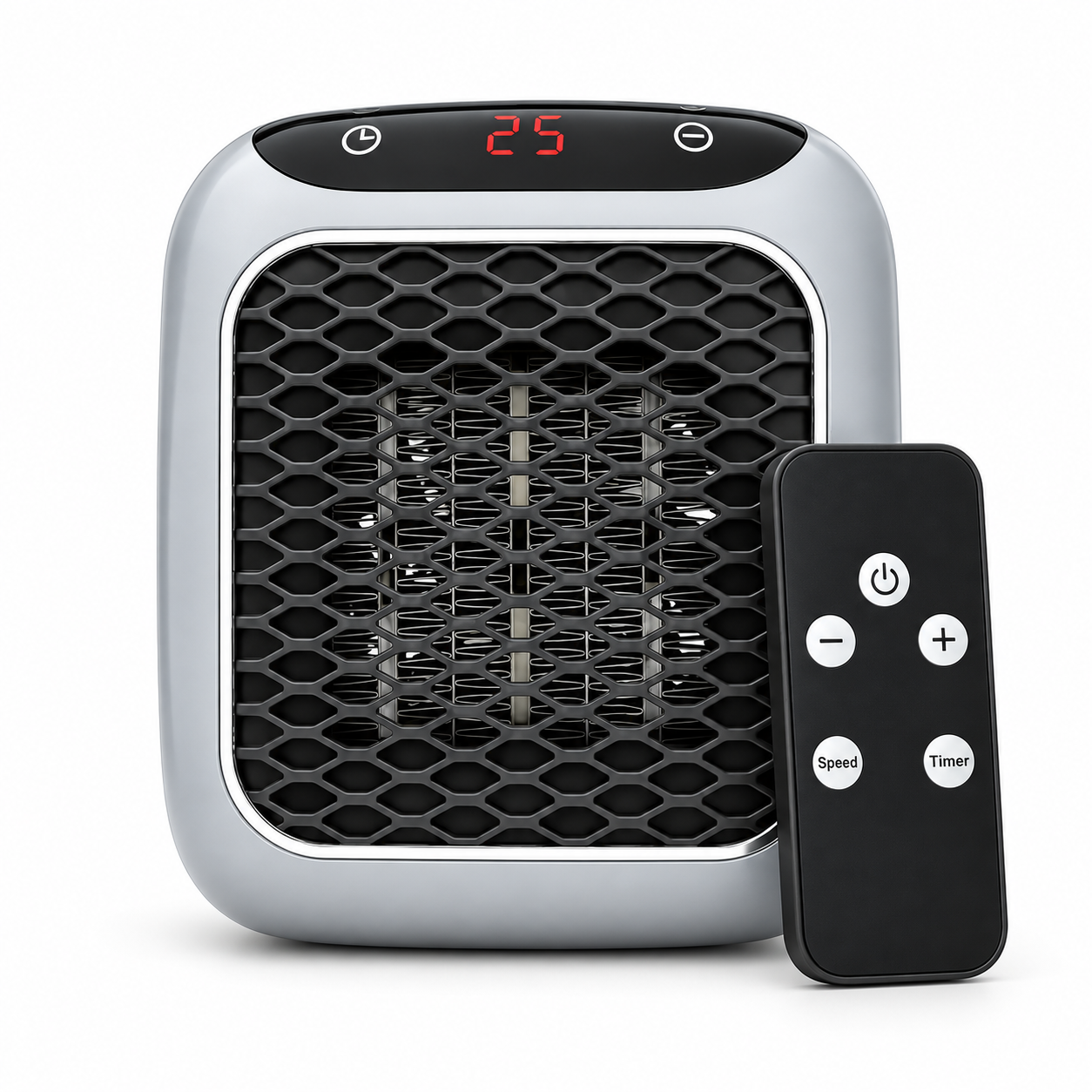
Recommended in this guide
The compact heater this guide keeps coming back to
RapidHeat is a portable ceramic fan heater for personal and supplemental room heating. Room results depend on insulation, drafts, ceiling height and starting temperature; it is not a whole-home heating replacement.
- Ceramic fan heating
- Remote control included
- Programmable timer
What do the timer and remote control?
The timer sets an automatic shut-off after a chosen number of hours. It adds a useful stop point, but it does not make unattended operation safe. The remote lets you adjust supported controls from across the room; consult the supplied guide for the exact buttons and modes on your unit.
For a full breakdown of the controls and first-use instructions, see the RapidHeat manual.
Airflow and placement: getting warm air where you sit
A ceramic heater moves warm air with a fan rather than radiating heat like an infrared panel, so placement affects how quickly you feel the benefit. A few placement principles make a real difference:
- Plug it directly into a wall outlet. Space heaters draw meaningful current, and extension cords or power strips are not recommended for any electric heater.
- Place it on a firm, flat surface at least three feet away from curtains, bedding, paper and furniture, with the rear air inlet unobstructed.
- Close the door. A closed room reaches temperature with far less duty-cycle time than an open hallway, as the worked example above shows. See quiet space heater picks if noise near a closed bedroom door is also a concern.
- Point it toward the seating or sleeping area, not directly at a wall. Warm air circulates better when it has open room to move and mix.
- Don't tuck it into a corner behind furniture. Blocked airflow at the rear inlet makes the fan work harder to pull in room air, which lengthens each duty cycle.
How do you use a ceramic heater safely?
| Do this | Avoid this |
|---|---|
| Plug straight into a wall outlet | Extension cords, power strips or splitters |
| Firm, flat, open surface | Carpeted or soft surfaces, or wedging it into a corner |
| Three feet of clearance on all sides | Placing it near curtains, bedding or stacks of paper |
| Switch it off before sleeping or leaving the room | Treating a timer as a substitute for supervision |
| Let the thermostat cycle naturally | Manually switching it off and on to "save power" — the thermostat already does this more efficiently |
Built-in features do not replace safe placement
Product information describes automatic shut-off protection, but no built-in feature can eliminate every risk. Keep the heater at least three feet from anything that can burn, never cover it, plug it directly into a wall outlet, and switch it off before leaving the room or going to sleep. For a deeper look at overall space heater safety, see are space heaters safe and is RapidHeat safe. The National Fire Protection Association also publishes general home-heating safety guidance.
How do you set up RapidHeat?
- 1. Unbox and inspect. Remove RapidHeat and the remote from the box, take off any protective film, and check the vents at the front and rear are clear of packaging material.
- 2. Choose a safe, flat surface. Place the heater on a firm, level surface at least three feet from curtains, bedding, furniture and paper, with the rear air inlet unobstructed.
- 3. Plug directly into a wall outlet. Connect the power cord straight into a standard 120V outlet. Do not use an extension cord or power strip.
- 4. Power on and set a temperature. Press power on the unit or remote, then use + / − to choose a target setting. Allow the fan and heating element to begin operating.
- 5. Set the timer if needed. While you remain nearby, use the timer if you want the heater to switch off after a fixed number of hours. A timer is not a substitute for supervision.
- 6. Let the thermostat take over. Once the room reaches your set temperature, the thermostat will cycle the heating element on and off automatically to hold it there without you touching the controls again.
RapidHeat controls and published product details
The details below summarize the product information supplied for this store. Always check the label and quick-start guide included with your unit before use.
- Heating method
- Fan-driven PTC ceramic heating
- Controls
- On-unit controls and handheld remote
- Temperature control
- Adjustable thermostat
- Timer
- Programmable automatic shut-off timer
- Power connection
- Standard 120V US wall outlet
- In the box
- Heater, remote control and quick-start guide
Frequently asked questions
Why does RapidHeat feel warm so much faster than a radiator?
A ceramic fan heater has relatively little material to warm before its fan moves heated air toward you. An oil-filled radiator must first warm its internal fluid and metal body, so its heat is usually felt more gradually.
Does the fan run all the time?
The fan runs while RapidHeat is actively delivering warm air. Its exact behavior during a thermostat cycle can vary by selected mode; follow the instructions supplied with your unit.
Why does RapidHeat cycle on and off instead of running constantly?
That is the thermostat responding to room temperature. It reduces or pauses heating near the selected setting, then resumes when more heat is needed. Cycling frequency depends on room size, drafts and the chosen temperature.
Does closing the door actually make a measurable difference?
Usually. Closing a room reduces the amount of warm air escaping into adjoining spaces. The result depends on insulation, drafts, room size and outdoor temperature, so it should not be treated as a guaranteed energy saving.
Is it normal for the unit to click when it starts or stops?
A soft click can occur when a thermostat-controlled heater starts, stops or changes heating state. Unplug the unit and contact support if you notice persistent burning odor, smoke, sparking, a damaged plug or unusual mechanical noise.
How much electricity will RapidHeat use?
Electricity use depends on its active wattage and how long the heating element runs. A thermostat may reduce active heating time after the room reaches the set temperature, but drafts, room size and temperature setting can keep the duty cycle high.
Want to see how it compares with the heating you already have? Read our side-by-side comparison, check what size space heater you need, or head straight to current bundle pricing.
Why buy direct from RapidHeat US
- Official US store — the same team that handles warranty claims
- Free shipping to eligible US delivery addresses
- 30-day return window and a 12-month limited warranty
- US-based email and phone support, not a marketplace reseller
Sources & how we got these numbers
- EIA Electric Power Monthly — US average residential electricity rate used in cost illustrations
- Energy.gov — Small Space Heaters — How space heaters are meant to be used efficiently
- NFPA — Home Heating Safety — General home heating safety guidance
Costs are illustrative and calculated at the US average residential electricity rate. Your own rate, room and usage will change the result. See our editorial standards.
Keep reading
Ready to warm the room you're actually in?
Bundles start at $59 with free eligible US shipping and a 30-day return window.
See bundles & order