Heating a Large or Open-Plan Room
This is where most space heater disappointment comes from. Here is what is physically possible and how to get the best result anyway.
The hard limit
A standard US 15 amp circuit supports about 1,800 watts, and heaters are built to stay safely under that at 1,500. That is a fixed ceiling. Using the common rule of about 10 watts per square foot, a single plug-in unit realistically serves around 130 to 150 square feet in a reasonably insulated room. No brand can exceed this from a wall outlet, whatever the listing says.
What that means for your room
- Up to 150 sq ft: one unit is the right answer.
- 150–300 sq ft: one unit warms the zone you sit in; two make the whole room comfortable.
- 300–500 sq ft open plan: two units, placed in the used zone, plus a lower central heating setting.
- Over 500 sq ft, or high ceilings: plug-in heaters are the wrong tool as a primary source. Use them to take the edge off where you sit.
Zone heating beats whole-room heating
In a large space, aiming to raise the temperature of every cubic foot is expensive and slow. Aim instead at where people are: the couch, the dining table, the desk. Two compact units around the seating area will make that area genuinely comfortable long before one unit has made any impression on the whole room.
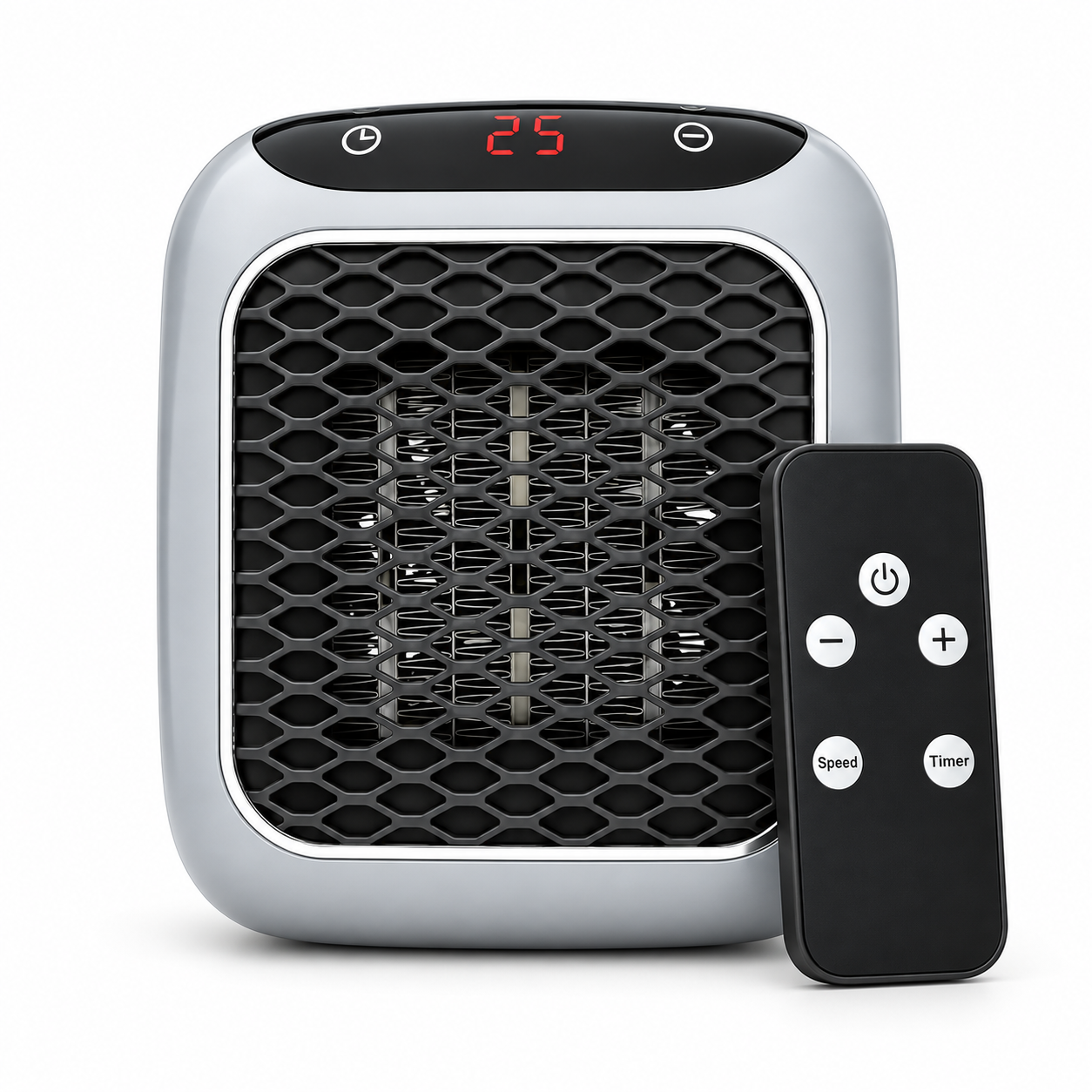
Recommended in this guide
The compact heater this guide keeps coming back to
RapidHeat is a hand-sized ceramic heater that plugs straight into a wall outlet, pushes out warm air in about a minute and switches itself off on a timer. It is built for warming one room properly, not a whole house.
- Warm in ~60 seconds
- Under 30 dB
- Auto shut-off & timer
Placement in an open-plan space
- Put units near the occupied zone, not in far corners
- Blow across the space rather than into a wall or a sofa back
- Close doors to hallways and stairwells; warm air escapes upward fast
- Rugs on hard floors and closed blinds at night hold noticeably more heat
- Put the two heaters on different circuits if you can, to avoid tripping a breaker
Ceiling height matters more than people think
The 10 watts per square foot guide assumes standard 8 foot ceilings. A vaulted or 12 foot ceiling adds 50% more air volume for the same floor area, and warm air rises away from you. In those rooms, ceiling fans on low winter reverse do genuine work pushing warm air back down.
Where RapidHeat fits
One RapidHeat suits a room up to about 130 square feet. For a large living space most customers take the two or three-unit bundle so they can cover the seating zone, and move a unit to the bedroom or office when it is not needed downstairs. See bundle pricing or work out your own requirement with what size heater you need.
Common questions
Can one space heater heat a large room?
Rarely. A standard US outlet caps a plug-in heater near 1,500 watts, which comfortably covers about 150 square feet. Rooms of 300 square feet or more generally need two units or a dedicated higher-output heater.
How many watts do I need for a 400 square foot room?
At the common rule of 10 watts per square foot, around 4,000 watts — which is far beyond one plug-in heater. In practice you would use two units on separate circuits to warm the occupied zone rather than trying to heat the whole volume.
Where should I place heaters in an open-plan space?
Do not put them at opposite ends. Place them to warm the zone people actually use — the sofa area, the dining table — and let convection do the rest. Blocking drafts from stairwells and hallways matters as much as wattage.
Keep reading
Ready to warm the room you're actually in?
Bundles start at $59 with free USA shipping and a 30-day money-back guarantee.
See bundles & order