How Much Does a Space Heater Cost to Run?
One formula, real US wattage tables, and the eight changes that actually reduce the bill.
The short answer
RapidHeat from $59
Free USA shipping · 30-day return window · Published store policies
The formula
(Watts ÷ 1,000) × hours × your rate per kWh = cost. A 1,500 watt heater run for 4 hours uses 6 kWh. At $0.17 per kWh (the illustrative US residential average reported by the US Energy Information Administration) that is $1.02. That is the whole calculation — everything else below is about how many hours the element genuinely draws power, and at what wattage.
Cost by wattage, at 1, 4 and 8 hours
The table below uses the illustrative rate of $0.17/kWh so you can compare wattages directly. Swap in your own rate — printed on your electric bill — in the running cost calculator.
| Heater setting | 1 hour | 4 hours | 8 hours | 30 days at 4 hrs/day |
|---|---|---|---|---|
| 500 W | $0.09 | $0.34 | $0.68 | $10.20 |
| 750 W (low) | $0.13 | $0.51 | $1.02 | $15.30 |
| 1,000 W | $0.17 | $0.68 | $1.36 | $20.40 |
| 1,500 W (full) | $0.26 | $1.02 | $2.04 | $30.60 |
Calculated at $0.17 per kWh, the illustrative US residential average. Rates vary widely by state — check your own bill.
Worked example: a typical evening routine
Say a household runs a 1,500W heater in the living room for 4 hours every evening, 30 days a month. At full power that is 6 kWh × 30 days = 180 kWh, or $30.60 at $0.17/kWh. If the thermostat holds the room at 70°F and the element only actually runs about 45% of that time (a realistic duty cycle in a closed room), real consumption drops to roughly 81 kWh and about $13.80 for the month — less than half the full-power number.
Key takeaway
Why your real cost is usually lower than the "full power" table
The table above assumes the element draws full power for the entire time it's switched on. A thermostat-controlled heater in a closed room does not work that way: it heats to the set temperature, switches the element off, and cycles back on only as the room cools. In a reasonably sealed room that duty cycle is often 40-60%, which roughly halves the figures above. A drafty room with a door left open can push the duty cycle back up toward 80-100%, erasing most of that saving — see heating a cold, drafty room for how to fix that specifically.
Monthly cost at typical usage patterns
| Usage pattern | Hours/day | Est. monthly cost (1,500W, 50% duty) |
|---|---|---|
| Evenings only | 3 | ~$11.50 |
| Home office, workdays | 8 (weekdays) | ~$22 |
| All day, occupied room | 12 | ~$46 |
| Overnight with timer cutoff | 2 | ~$7.70 |
Recommended in this guide
The compact heater this guide keeps coming back to
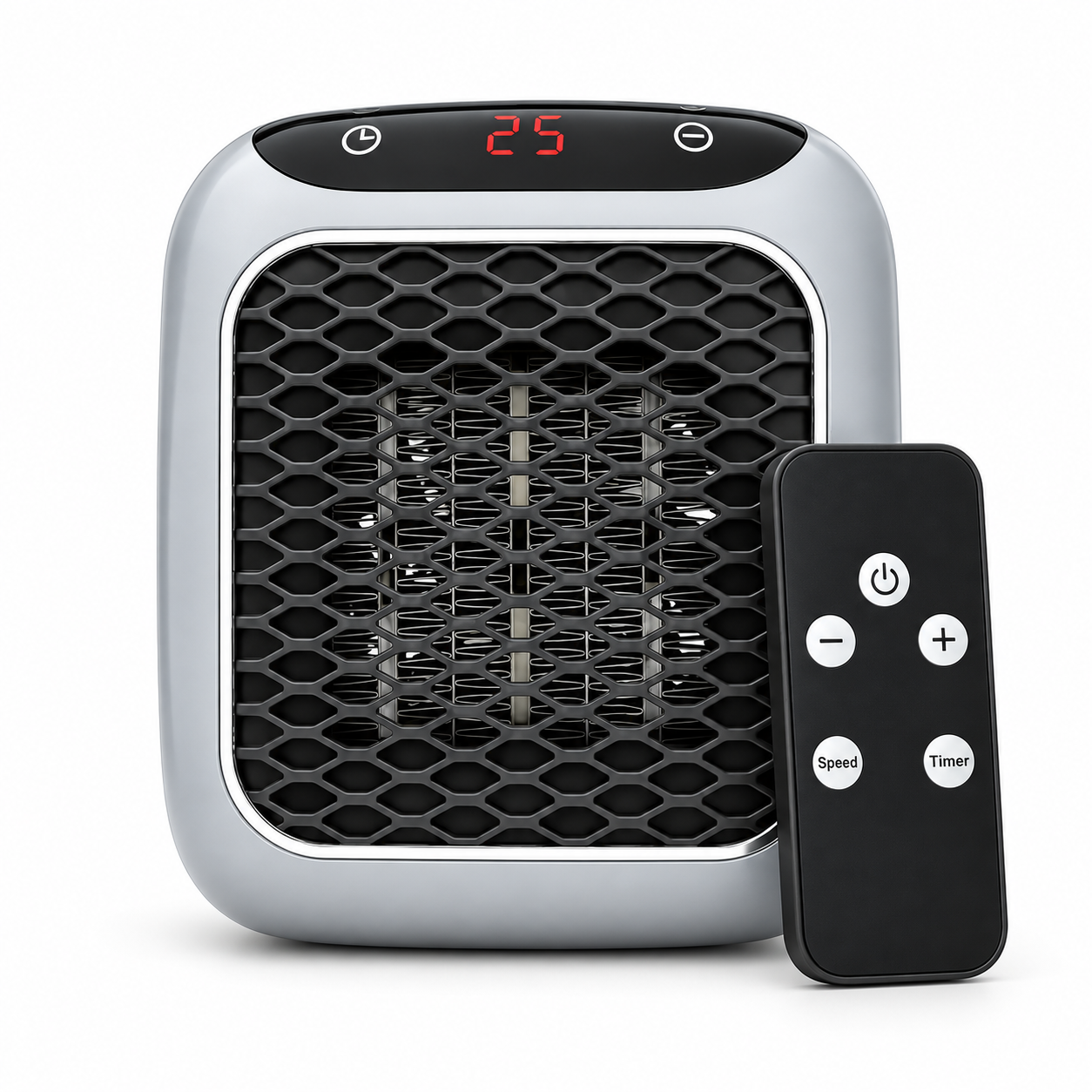
RapidHeat is a portable ceramic fan heater for personal and supplemental room heating. Room results depend on insulation, drafts, ceiling height and starting temperature; it is not a whole-home heating replacement.
- Ceramic fan heating
- Remote control included
- Programmable timer
How a thermostat cuts real-world cost
Every dollar figure above depends on duty cycle — the percentage of time the heating element is actually drawing power versus idling while the thermostat holds temperature. A heater with an accurate degree-level thermostat, like RapidHeat's control panel, reaches the set point and then throttles back rather than running flat out the whole session. Cheaper heaters with only "high/low" settings and no true thermostat tend to either overheat the room and vent the excess warmth out a door, or run continuously on low without ever quite reaching comfort — both waste energy.
Comparing to central heating
The honest comparison is not heater versus furnace — it is one warm room versus a whole warm house. If you are the only person home and you spend the evening in one room, a space heater plus a lower central setting is normally cheaper. With a full house in several rooms at once, central heating wins. See space heater vs central heating for the full comparison and a household worked example.
What to look for if you want a lower bill
- A true thermostat with degree settings, not just high/low
- A built-in programmable timer so you never forget to switch it off
- Fast warm-up, so you aren't running it for 20 minutes before it does anything
- The lowest wattage that still keeps your room comfortable
What to avoid
- Running a heater with the door open to the rest of the house
- Using it in addition to full central heating rather than instead of it
- Leaving it on high all session when the thermostat could hold a lower, comfortable setting
Eight ways to cut the cost
- Use the timer. Two hours instead of eight is a 75% cut, immediately.
- Turn the central thermostat down. Otherwise you have added a cost rather than replaced one.
- Close the door and block the draft underneath. Free, and it shortens every heating cycle.
- Run on low or set a specific temperature. A lower setting held longer often uses less than a high setting cycling hard.
- Heat the room you are in, only while you are in it. This is the entire point of zone heating.
- Size the heater to the room. Oversizing wastes energy overshooting the temperature; see what size space heater do I need.
- Check your actual rate. Rates in your state may be well above or below the $0.17 average used here.
- Seal drafts around windows and doors. Every degree of heat that leaks out has to be replaced by the element running longer.
Common questions
How much does it cost to run a 1500W space heater for 24 hours?
A 1,500 watt heater running continuously for 24 hours uses 36 kWh. At the US average of about $0.17 per kWh that is roughly $6.12 a day. In practice a thermostat-controlled heater cycles off, so real usage is usually far lower.
Is it cheaper to run a space heater or central heating?
Heating one occupied room with a space heater while turning the central thermostat down is usually cheaper. Running a space heater on top of full central heating always costs more.
Do space heaters use a lot of electricity?
They are among the higher-draw appliances in a home — a 1,500 watt heater uses more than a refrigerator, a TV and a laptop combined. The cost is controlled by how many hours it actually draws power, which is what the thermostat and timer are for.
What size space heater is cheapest to run?
The smallest wattage that still keeps the room comfortable, because cost scales directly with watts. A 750W heater run twice as long as a 1,500W heater costs the same — the real lever is total hours at full power, not the wattage label alone.
Does running a space heater on low really save money?
Usually yes. A low or eco setting draws fewer watts per hour, and if it still keeps the room comfortable it lowers total kWh used even though it may run slightly longer to compensate.
How much does a space heater add to a monthly electric bill?
For 4 hours a day at 1,500W and $0.17/kWh, roughly $30 a month at full draw, often $15-$20 in practice once thermostat cycling is accounted for. Heavier daily use in a large or drafty room can push that higher.
Why buy direct from RapidHeat US
- Official US store — the same team that handles warranty claims
- Free shipping to eligible US delivery addresses
- 30-day return window and a 12-month limited warranty
- US-based email and phone support, not a marketplace reseller
Sources & how we got these numbers
- US Energy Information Administration — Electric Power Monthly — residential electricity rate data used for the illustrative $0.17/kWh figure
- Department of Energy — Small Space Heaters — guidance on zone heating and efficient use
Costs are illustrative and calculated at the US average residential electricity rate. Your own rate, room and usage will change the result. See our editorial standards.
Keep reading
Ready to warm the room you're actually in?
Bundles start at $59 with free eligible US shipping and a 30-day return window.
See bundles & order