Small Plug-In Wall Heaters: The Honest Guide
They are cheap, compact and everywhere online. Here is what they genuinely do, where they fall short, and how to buy one that is not a fire hazard.
The short answer
RapidHeat from $59
Free USA shipping · 30-day return window · Published store policies
What a plug-in heater is
A small plug-in heater is a compact unit that sits at or near a wall outlet and pushes warm air into the room using a ceramic PTC element and a small fan. There is no installation, no wiring and no wall mounting — you plug it in and it runs. The trade-off is scale: a plug-in unit draws what a standard household outlet can supply, which caps how much heat it can produce.
Compact heater types compared
| Type | Typical wattage | Coverage | Best for |
|---|---|---|---|
| Ceramic PTC plug-in | 750–1,500 W | Up to ~130 sq ft | Bedrooms, offices, dorms, RVs |
| Mini oil-filled radiator | 700–1,500 W | Up to ~150 sq ft, slower | Rooms warmed in advance, silent overnight use |
| Small infrared panel | 400–1,000 W | Spot heating, not whole-room | A desk, a chair, a garage workbench |
| Wall-mounted hardwired unit | 1,500–4,000 W | Larger rooms, requires an electrician | Bathrooms, permanent installs, larger spaces |
What it can realistically do
- Provide personal or supplemental warmth in a suitable occupied room
- Move heated air with a fan after startup
- Hold a set temperature with a thermostat once the room is warm
- Let you turn the central heating down for the rest of the house
What it cannot do
- Heat a whole house or an open-plan floor from one unit
- Win against an uninsulated garage in a cold climate
- Beat physics — every electric heater turns roughly the same electricity into roughly the same heat
Key takeaway
Recommended in this guide
The compact heater this guide keeps coming back to
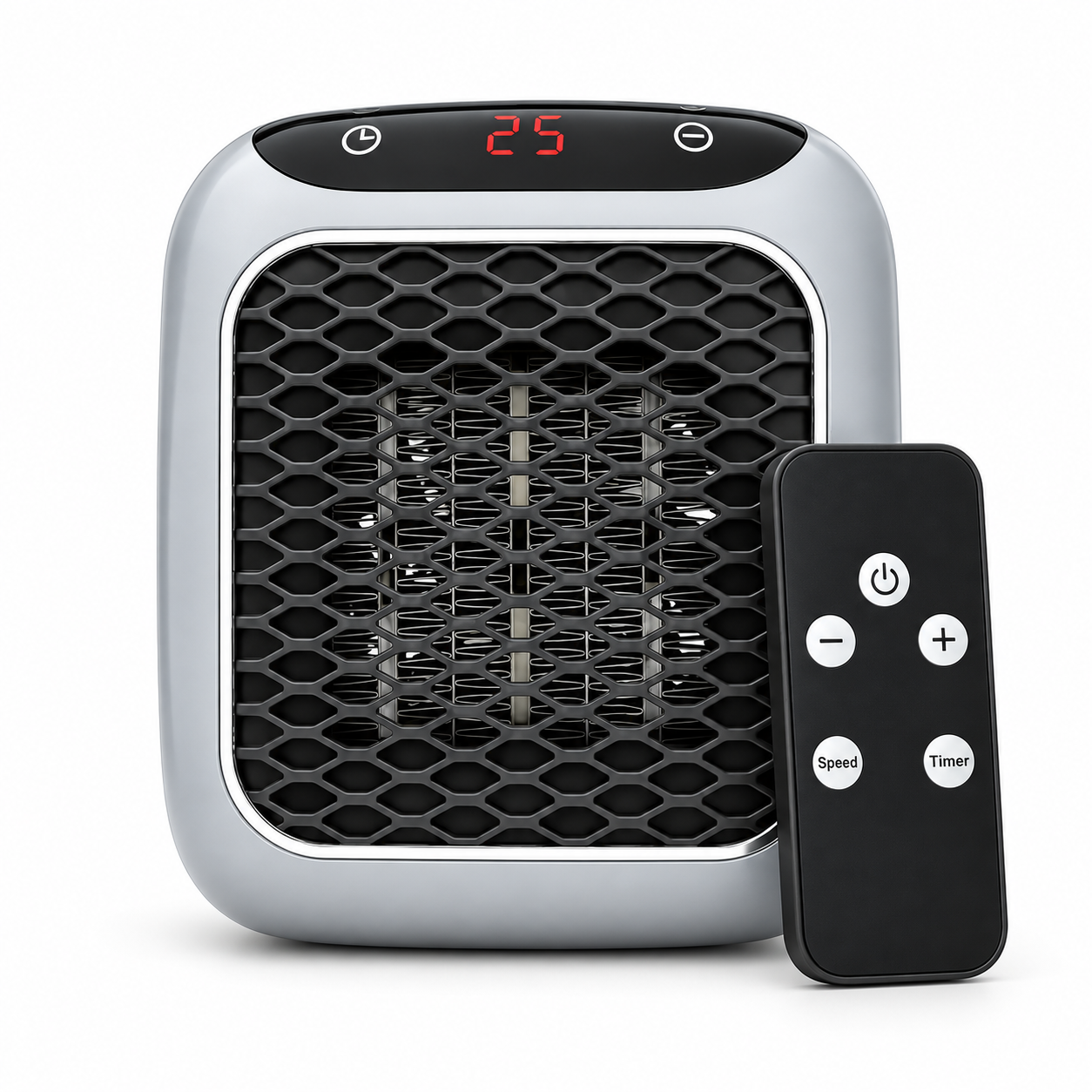
RapidHeat is a portable ceramic fan heater for personal and supplemental room heating. Room results depend on insulation, drafts, ceiling height and starting temperature; it is not a whole-home heating replacement.
- Ceramic fan heating
- Remote control included
- Programmable timer
Wattage vs. room size: where these units shine, and where they fail
US outlets on a 15 amp circuit cap out near 1,800 watts, so 1,500 watts is the ceiling most plug-in heaters target. That makes them excellent for the rooms they are built for, and a poor fit outside that range.
| Room size | Plug-in heater fit |
|---|---|
| Under 100 sq ft (nook, small bedroom, RV) | Excellent — a single small unit is ideal |
| 100–150 sq ft (standard bedroom, office) | Good — a 1,200–1,500 W unit fits well |
| 150–250 sq ft (large bedroom, small living room) | Workable with one unit on high, or two units |
| 250+ sq ft open plan area | Poor fit — needs multiple units or central heating |
Use our sizing calculator guide for an exact wattage recommendation for your room.
Outlet and circuit considerations
Before buying, check what else is on the circuit you plan to use. A hair dryer, space heater and a window AC unit sharing one 15 amp circuit is a classic way to trip a breaker. If you're not sure which outlets share a circuit, most homes group outlets by room or by wall, and a quick check with your breaker panel will confirm it. Never use a heater on a shared power strip with other high-draw devices.
Safety rules that are not optional
- Plug directly into a wall outlet — never an extension cord, power strip or timer plug
- Three feet of clearance from bedding, curtains, furniture and paper
- Hard flat surface, never deep carpet that blocks the base intake
- Buy a unit with overheat protection, tip-safe design and a programmable shut-off timer
- Do not run an unattended heater with no timer overnight
The longer version is in are space heaters safe.
What to look for, and what to avoid
| Look for | Avoid |
|---|---|
| Ceramic PTC element with fast warm-up | Bare exposed coil elements |
| Listed overheat protection and tip-over shut-off | No stated safety certifications or cut-offs |
| A real thermostat with degree-level control | High/low switch only, no thermostat |
| Stated coverage in square feet, not vague claims | "Heats any room" marketing with no size guidance |
Where RapidHeat fits
RapidHeat is a portable ceramic fan heater with a programmable timer and remote control. Check the product label and supplied instructions for electrical and safety details, and match it to your room conditions rather than relying on a universal coverage claim. See how it works or check bundle pricing.
Common questions
Do small plug-in wall heaters really work?
Yes, for the job they are designed for: warming one small-to-medium room you are occupying. They will not heat a house or a large open-plan floor, and any product claiming otherwise is overselling.
How many square feet will a plug-in heater cover?
There is no universal coverage figure. Fit depends on wattage, ceiling height, insulation, drafts and starting temperature; use the maker's documented sizing guidance for a specific model.
Can I plug a wall heater into an extension cord?
No. Heaters draw high current and extension cords and power strips are a genuine fire risk. Always plug a heater directly into a wall outlet.
What is the difference between a plug-in heater and a hardwired wall heater?
A plug-in unit sits near an outlet and can be moved from room to room with no installation. A hardwired wall heater is permanently mounted, wired into a dedicated circuit by an electrician, and generally rated for more watts and a larger room, but cannot be relocated.
Will a plug-in heater trip my breaker?
It can if the circuit is already carrying other appliances close to its rated load. A 1,500 watt heater draws about 12.5 amps, most of a standard 15 amp circuit, so avoid running it alongside other high-draw devices on the same outlet run.
Is a more expensive plug-in heater actually better?
Sometimes, but not because of raw heat output — a 1,500 watt heater is a 1,500 watt heater regardless of price. Extra cost is usually justified by a more accurate thermostat, quieter fan, sturdier housing and better safety cut-offs, not more warmth.
Why buy direct from RapidHeat US
- Official US store — the same team that handles warranty claims
- Free shipping to eligible US delivery addresses
- 30-day return window and a 12-month limited warranty
- US-based email and phone support, not a marketplace reseller
Sources & how we got these numbers
- Department of Energy — Small Space Heaters — Guidance on wattage, sizing and safe operation of plug-in heaters.
- National Fire Protection Association — Home Heating Safety — Outlet, cord and clearance recommendations referenced above.
- U.S. Energy Information Administration — Electric Power Monthly — Reference for electricity rate figures used in cost estimates elsewhere on this site.
Costs are illustrative and calculated at the US average residential electricity rate. Your own rate, room and usage will change the result. See our editorial standards.
Keep reading
Ready to warm the room you're actually in?
Bundles start at $59 with free eligible US shipping and a 30-day return window.
See bundles & order