Quiet Space Heaters: What the Numbers Mean
Every heater is advertised as quiet. Decibels tell you the truth — here is how to read them and what to expect in a real room.
| Noise level | Comparable to | In a bedroom |
|---|---|---|
| Under 30 dB | Whisper, quiet library | Fine for light sleepers |
| 30–40 dB | Soft rainfall | Noticeable but easy to sleep through |
| 40–50 dB | Refrigerator hum | Will bother light sleepers |
| 50–60 dB | Normal conversation | Too loud for a bedroom or a call |
Where heater noise comes from
- The fan. The main source. Bigger, slower fans move the same air more quietly than small fast ones.
- Air turbulence. Narrow grilles whistle. A well-shaped outlet does not.
- The thermostat relay. A soft click each time the element cycles. Normal.
- Expansion ticking. Metal parts expanding on warm-up and contracting on cool-down.
- Rattle. Always a fit problem — a loose panel or the unit sitting on an uneven surface.
Quiet by heater type
- Oil-filled radiator: silent, no fan. Slow to warm up, heavy to move.
- Ceramic with a low setting: the best balance — fast heat and around 30 dB on low.
- Infrared panel: near-silent but heats objects rather than the room.
- Basic fan heater: the loudest category. Avoid for bedrooms and offices.
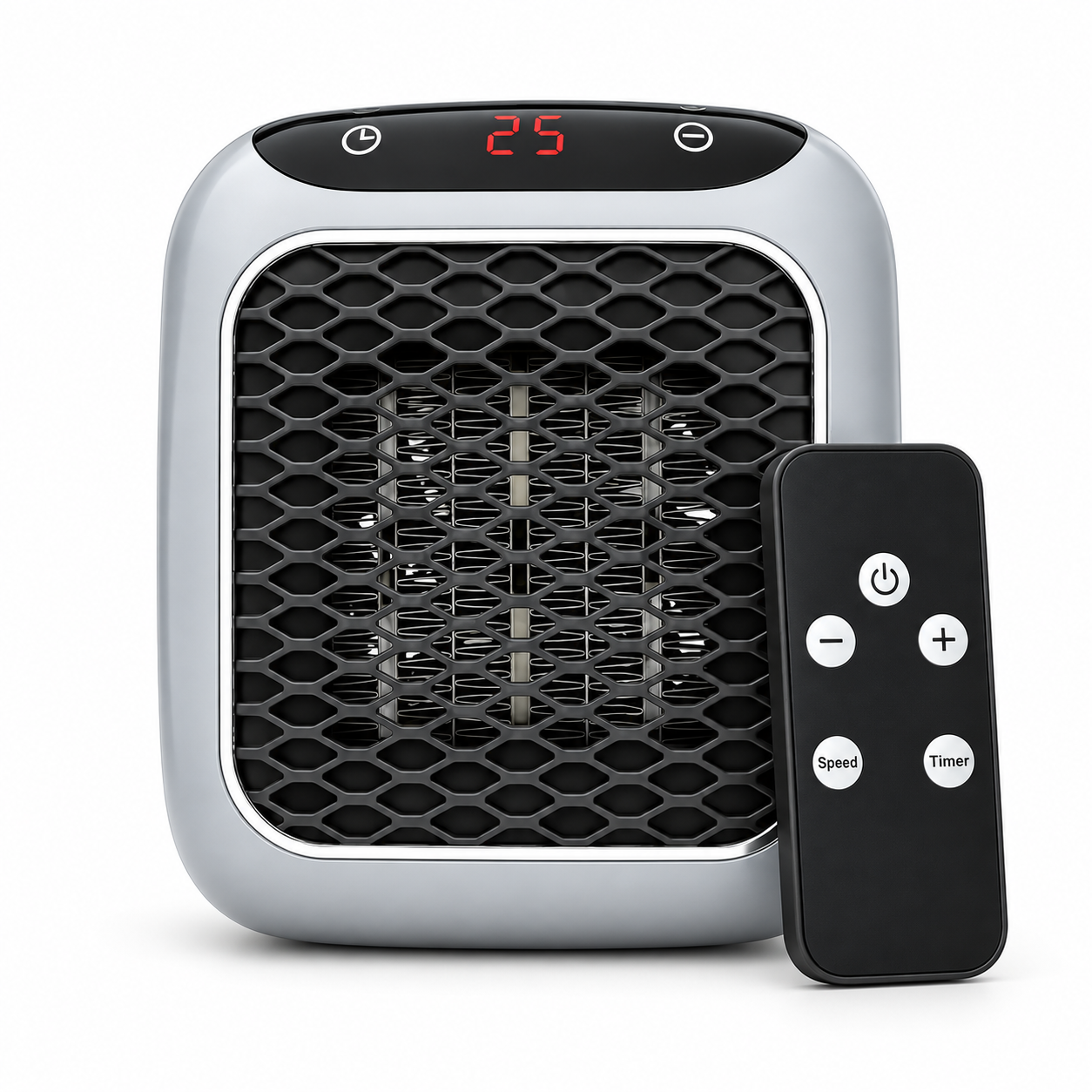
Recommended in this guide
The compact heater this guide keeps coming back to
RapidHeat is a hand-sized ceramic heater that plugs straight into a wall outlet, pushes out warm air in about a minute and switches itself off on a timer. It is built for warming one room properly, not a whole house.
- Warm in ~60 seconds
- Under 30 dB
- Auto shut-off & timer
How to make any heater quieter
- Run it on low and let it work longer, rather than high in short bursts
- Set the thermostat sensibly so it cycles less frequently
- Stand it on a hard level surface — not a hollow floorboard or a wobbly shelf
- Keep the rear intake and filter clean; a blocked filter makes the fan work louder
- Leave a few inches of clearance so air is not forced through a gap
Where RapidHeat fits
RapidHeat runs under 30 dB, which is why it is popular in nurseries, bedrooms and home offices. It has multiple speed settings, a thermostat and a remote, so you can adjust it without getting up. See the bedroom guide or check bundle pricing.
Common questions
How many decibels is a quiet space heater?
Around 30 dB or below is genuinely quiet — roughly a whisper or a soft library. Between 40 and 50 dB you will notice it in a silent bedroom. Above 55 dB it will be audible on a video call.
What is the quietest type of heater?
An oil-filled radiator is effectively silent because it has no fan, but it is slow and heavy. Among fan-driven heaters, a good ceramic unit on its low setting is the quietest practical option.
Why does my heater click?
Clicking is usually the thermostat relay switching the element on and off, or metal parts expanding as they heat. Occasional clicks are normal; constant rapid clicking suggests the thermostat is set right at the current room temperature, so nudge it a degree either way.
Keep reading
Ready to warm the room you're actually in?
Bundles start at $59 with free USA shipping and a 30-day money-back guarantee.
See bundles & order